
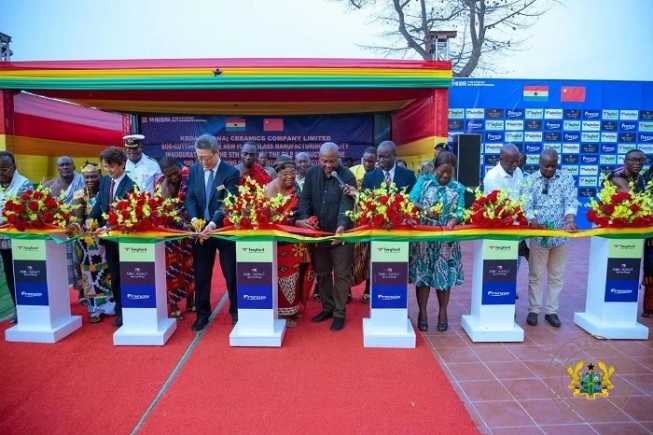
The country will start the production of glass in 18 months for domestic and industrial use.
The $250-million float glass manufacturing facility, located at Shama in the Western Region, expected to be one of the largest in Africa, will be delivered in two phases, with the first phase producing 600 tonnes of finished products per day.
At full capacity, the plant will produce 1,400 tonnes of glass daily.
The first phase will be commissioned in August next year.
President John Dramani Mahama cut the sod for the construction of the new factory at Shama last Tuesday, and described the moment as the nation’s “industrial resurgence.”
The factory will use the float glass manufacturing technology, a type of high-quality, flat and transparent glass produced by floating molten (liquefied) glass on a bed of molten tin, resulting in uniform thickness and a smooth, distortion-free surface which will be used for windows, mirrors, picture frames, furniture and general non-safety items.
Commissioning
Before cutting the sod, President Mahama had earlier commissioned a new sanitary ware factory and phase five of a ceramic tile production line.
The factories are owned and operated by the KEDA (Ghana) Ceramics Company Limited.
With the new lines and the glass factory on the horizon, the President said the company was on track to contribute over GH¢1 billion in taxes annually once the float glass facility reached full production.
He disclosed that in 2025 alone, the company paid GH¢740 million in taxes to the Ghana Revenue Authority (GRA) in spite of the economic headwinds.
“Now, when the float glass factory is at full production from August next year, the tax contribution to the Ghana Revenue Authority from Shama will exceed GH¢1 billion cedis,” President Mahama announced to thunderous applause.
He connected the massive tax contribution directly to national development, telling the workers: “That is the revenue we use to build schools for our children.
That is the revenue we use to build hospitals for our people. And the revenue we use to build roads so that we can connect our people to markets.”
“This is not merely an expansion of factories.
This is a statement to the world that Ghana is no longer content to be a consumer and import economy,” President Mahama said.
He added: “We are determined to produce, to process, to manufacture and to export.”
The President used the platform to announce new incentives for manufacturers under the newly signed 24-Hour Economy Authority, including duty and tax exemptions on capital equipment for factories registered under the initiative.
Game-changing exports
President Mahama emphasised the massive economic impact of Keda’s investments, saying currently, 60 per cent of the ceramic tiles produced in Shama were being exported to over 20 countries, including the United States, Italy and France.
“When you take the time, you look behind it, and you see ‘Made in Ghana,’ it makes us feel very proud,” he said, referring to tiles now being sold in Europe.
The new float glass factory is projected to generate nearly $100 million annually in export earnings at full capacity, while saving the nation millions currently being spent on the importation of glass.
President Mahama was also given a guided tour of the sprawling facility, and what he saw left him visibly impressed.
The factory, on the once-quiet Shama landscape, is a self-sustaining industrial community, conceived through the lens of Chinese urban planning.
Manicured lawns stretch between massive production halls, while rows of bamboo and clusters of vibrant flowers soften the edges of the industrial complex.
Ornamental trees, still young but thriving, line the internal road networks, their leaves rustling in the coastal breeze.
Most striking, however, are the man-made lakes that dot the property.
These serene water bodies, integrated into the facility's drainage and cooling systems, double as aesthetic masterpieces, reflecting the sky and providing a habitat for local birdlife.
The effect is surreal, a high-tech manufacturing zone that feels partly like a botanical garden.
New line
From the thunderous roar of the tile presses in the newly inaugurated phase five line now producing 200,000 square metres of tiles daily, to the precision engineering of the sanitary ware division, the
President observed closely, asking questions and engaging with the Ghanaian engineers and technicians who now run the show.
The impression was profound. When he later mounted the podium, the awe of what he had witnessed was evident in his words.
Jobs for the youth
The President revealed that the latest expansion would create a total of 2,182 direct jobs (729 during construction and 1,453 permanent roles), in addition to the 4,500 already generated by existing operations.
He called on the staff to “treat the factory like your own” to ensure its longevity for future generations.
President Mahama commended the Chairman of Twyford Group, the mother company of KEDA (Ghana) Ceramics Company Limited, Shen Yanchang, for his belief in Ghana, recalling their meeting in China last October where the new investments were mooted.
“This is how to build a strong economy. This is how to build a strong currency. Production underpins the value of currency; not by speculation, but by production and exports,” he stressed.
The ceremony was attended by the Minister of Trade, Agribusiness and Industry, Elizabeth Ofosu-Adjare, the Western Regional Minister, Joseph Nelson, the Member of Parliament for Shama, Emelia Arthur, traditional rulers from the Shama area, who have provided nearly 800 acres of land for the industrial enclave, among other guests.
99% Local raw materials
The Managing Director of KEDA (Ghana) Ceramics Company Limited, Li Wei, in his address revealed that 99 per cent of raw materials used in the company's manufacturing processes was now sourced locally.
“This strategic focus on local content has strengthened the domestic supply chain and retained economic value within Ghana,” he said.
Beyond the 4,500 direct employees, the company's operations have generated more than 15,000 indirect jobs, supporting thousands of Ghanaian families.
The MD also announced that 47 Ghanaian employees had advanced into key leadership positions, with the number expected to rise to 60 by the end of the year, demonstrating a clear commitment to skills transfer and localisation.
Minister's China visit seals deal
The Managing Director also shared the fascinating backstory of how the new $250 million float glass factory came to be.
He recalled a visit by the Minister of Trade, Agribusiness and Industry to the company's headquarters in Foshan, China, in June 2025.
"She delivered a clear and compelling message: Ghana is ready for investment, the conditions were favourable, and Keda possessed the capability to establish a world-class glass manufacturing facility in Ghana," he recounted.
When the minister returned to China in October 2025 with President Mahama, the company was ready with its decision — a decision celebrated last Tuesday with the sodcutting.
