
FIFA president justifies costly World Cup ticket prices in 'very special market'
FIFA president Gianni Infantino has defended the pricing of World Cup match tickets for this summer’s tournament by insisting that global soccer’s world governing body is a non-profit organisation and citing what he described as a “special market” compared to concerts or NFL matches.
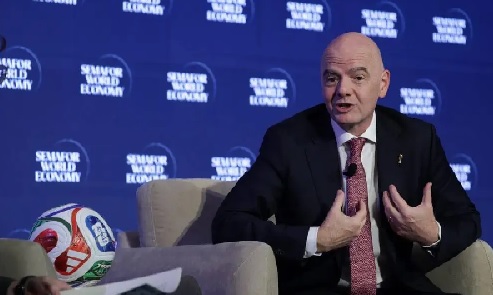
Speaking at the Semafor World Economy 2026 Annual Convening on Friday, Infantino reiterated that FIFA is a not-for-profit organisation, explained that it only has the opportunity to draw revenue on a quadrennial basis, and insisted that it is trying to find the “right balance” in order to distribute money between its 211 member nations.
“The main, and so far the only, revenue-generating event for FIFA is the World Cup,” Infantino said. “The World Cup takes place one month every four years, so we generate money in one month. The 47 months until the next World Cup, we spend that money.
“What many people don’t know, because of course we generate billions in a World Cup, people don’t know FIFA is a non-for profit organisation, which means all the revenue we generate, we invest them in the organisation of the game, in 211 countries all over the world. Three quarters of which probably would not be able to have organised football without the grants we could give them, so we always try to find the right balance.”
Since the first batch of sales in October, FIFA has increased ticket prices in its dynamic-pricing model, with The Athletic reporting earlier in April that tickets to roughly 40 of the World Cup’s 104 matches were more expensive in the “last-minutes sales phase” than they had been in any previous ticketing phase, according to fans who gained access and shared screenshots or numbers.
The creation of new ticket categories has also caused frustration and confusion among buying fans.
Infantino described the market for World Cup tickets in the U.S. as “very special”, suggesting “no one complains” about ticket prices “when you go to a concert or an NFL game”.
When challenged on that point, Infantino replied: “Maybe, but it’s the market.”
In March, fans’ group Football Supporters Europe (FSE) and consumer rights organisation Euroconsumers submitted a formal complaint to the European Commission over the “sky-high” prices, alleging that FIFA has abused its “monopoly position to impose excessive ticket prices and opaque and unfair purchasing conditions on European fans”.
Speaking Friday, Infantino referenced the $60 ticket category available for “hardcore fans”, which he said is also in place for the final. This category has been a point of contention since tickets first went on sale in October, with fans’ groups across Europe pointing out that hardly any tickets were available at this price when the overseas sales window opened. FIFA then made more available in December.
Infantino also said he “didn’t know” prior to the process that the reselling of tickets in the U.S. is legal — albeit regulated at state level.
Meanwhile, Infantino said FIFA is in “constant discussions” with the U.S., Canadian and Mexican governments in order to ensure ticket-holding fans from countries who are restricted entry into the U.S. will be able to attend matches.
Since President Donald Trump returned to power in January 2025, the U.S. has imposed a series of travel bans on nationals from designated countries, including four nations (Senegal, Ivory Coast, Iran, and Haiti) that have qualified for the World Cup.
Infantino said FIFA “will make sure that all the teams, players, officials can come, including of course family members and even fans”.
“Of course, there always needs to be a visa,” he said, before referencing the FIFA Pass, an expedited visa appointment system for ticket holders which he feels “works quite well”.
“But also for those countries that have difficulties obtaining that visa, to have a situation where we can have fans of these countries.”
The New York City mayor, Zohran Mamdani, told The Athletic in January he intended to raise the impact of travel bans on the World Cup with Trump, saying it is “something (he) hopes will change” ahead of the tournament.
