

The Deputy Attorney-General and Minister for Justice, Dr Justice Srem-Sai, has confirmed that the Attorney-General’s Department will assume control of all criminal prosecutions currently being handled by the Office of the Special Prosecutor (OSP), in compliance with a High Court order.
The decision follows a ruling by the Accra High Court on Wednesday, April 15, 2026, which directed that all ongoing prosecutions initiated by the OSP be taken over by the Attorney-General until the required authorisation for such prosecutions is secured. The court further declared the OSP’s ongoing prosecutions null and void pending compliance.
The ruling stemmed from a legal challenge filed by an accused person, Peter Archiblod Hyde, who questioned the OSP’s authority to initiate and conduct prosecutions without prior authorisation from the Attorney-General. His legal team argued that both the Constitution and the Office of the Special Prosecutor Act require such authorisation before proceedings can lawfully commence.
Court records, according to the Deputy Attorney-General, indicated that the OSP was unable to demonstrate that it had obtained the necessary approval, prompting the court’s directive for the Attorney-General to take over the cases.
In a statement shared on social media on Thursday, April 16, Dr Srem-Sai said the Attorney-General’s Department would fully comply with the ruling and begin steps to implement the order in the coming days.
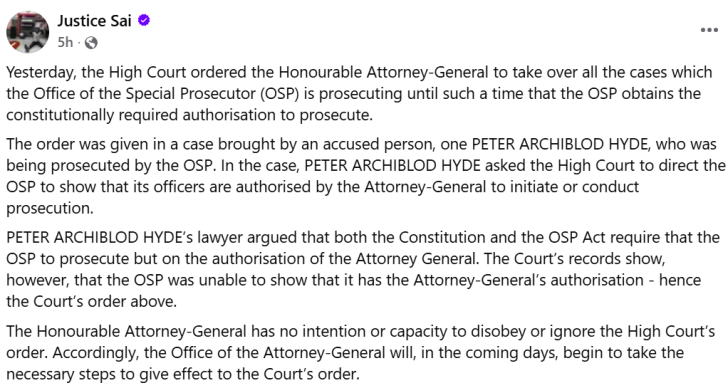
“The Honourable Attorney-General has no intention or capacity to disobey or ignore the High Court’s order. Accordingly, the Office of the Attorney-General will, in the coming days, begin to take the necessary steps to give effect to the Court’s order,” he stated.
He added that the Department remained committed to the rule of law and would ensure a smooth transition in handling the affected cases.
The ruling represents a significant development in Ghana’s anti-corruption prosecution framework, as it temporarily shifts active cases from the OSP to the Attorney-General’s Department while questions over prosecutorial authorisation are addressed.
Meanwhile, the Office of the Special Prosecutor has indicated that it will challenge the High Court’s decision, signalling a potential legal confrontation over the scope of its prosecutorial mandate and institutional independence.
