
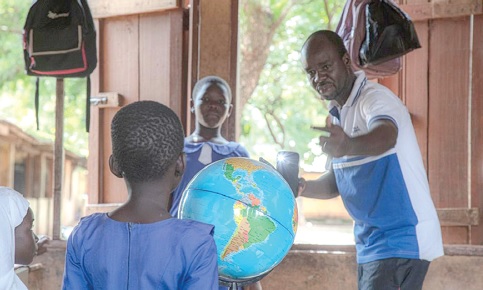
Teacher professional devt improves learning outcomes
Ghana’s quest for inclusive and high-quality education has received a major boost as the Teacher Professional Development (TPD) Model, introduced in 2018, has shown measurable improvements in teaching quality, student learning, and community-school relations.
The initiative, designed by School for Life (SfL), in partnership with Ghana Venskab (GV), was developed to complement government efforts in equipping teachers with practical skills for lesson delivery.
Unlike traditional one-off workshops, the TPD Model emphasises continuous professional development (CPD), giving teachers hands-on tools directly linked to classroom realities.
Evidence of Change
An independent assessment across seven schools in the Northern Region revealed that teachers who engaged with the TPD manual demonstrated significant gains in lesson planning, classroom management and teacher-pupil relations.
For instance, at Kpligine Primary School in the Mion District, the average mathematics score jumped from 48.18 to 58.48 in two academic years.
Overall, 37.4 per cent of the learning improvements in Mathematics, English and Science were directly attributed to the intervention. This implies that while the numbers may appear modest, they represent a moderate to large effect size in education research—an outcome rarely seen in large-scale interventions.
Aside from that, the TPD manual guides teachers to structure lessons into three phases—Starter, Main and Plenary—built around SMART objectives.
It also encourages respect, constructive feedback and positive reinforcement over punitive discipline.
At Salinkpang A.M.E Zion Primary School, for instance, a science teacher used the “starter” phase to spark curiosity with a simple experiment, followed by group discussions and feedback sessions that kept pupils engaged throughout.
Beyond classroom practices, the model has also strengthened community-school relations.
The Headteacher of Nuru-Islam Primary School in the Karaga District, Mohammed Shani, reported that enrolment and attendance had improved after teachers applied the TPD strategies.
He added that parents who were motivated by the intervention mobilised resources to build teacher quarters, repair classrooms and connect the school to electricity.
National Adoption
Stakeholders in the Education sector have stressed the need for the Ministry of Education and the Ghana Education Service (GES) to formally adopt the TPD Model as part of Ghana’s national CPD framework.
They opined that scaling the model would help the country fully realise the objectives of its standards-based curriculum, which emphasised creativity, equity and critical thinking.
A Technical Advisor for Education at School for Life, Abdul Rahim Fuseini, said the evidence showed the model was ready for national adoption.
“The TPD Model has moved teachers from rote teaching to interactive, learner-centred methods.
We have seen real improvements in children’s participation and performance, as well as stronger collaboration between schools and their communities,” he said.
SDGs
The model aligns with Ghana’s commitments to Sustainable Development Goal 4 on quality education, making it a cost-effective and scalable approach to long-term education reform.
The future of Ghana’s education rests on the shoulders of its teachers.
The TPD Model is a proven blueprint that can transform classrooms, schools and communities if scaled nationally.
