
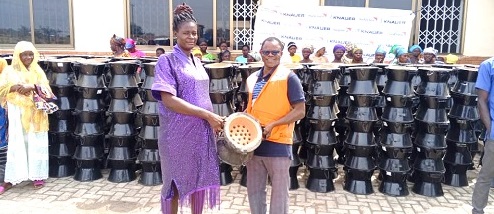
World Vision distributes 1,000 energy-saving stoves to women in Binduri
World Vision Ghana has distributed 1,000 energy-efficient cookstoves, popularly known as Gyapa, to households in the Binduri District as part of efforts to reduce deforestation, improve community health and promote sustainable household energy use.
The distribution ceremony, held last Tuesday at the Binduri District Assembly, brought together district officials and beneficiaries drawn from 30 communities, including Agoldaboo, Agumsi, Akpagoogo, Atuba Avoose, Atuba Mognori, among others.
FMNR plus Project
The distribution of the stoves formed part of World Vision’s Farmer Managed Natural Regeneration (FMNR) Plus Project, with funding support from KNAUER Family and Company, which is scaling up interventions in environmental protection and climate resilience across northern Ghana.
The project, currently in Phase II from May 2024 to March 2026, aims to reach 5,000 individuals and deepen efforts in environmental governance, disaster risk reduction, sustainable livelihoods and financial inclusion.
Turning point
In a speech delivered on behalf of the Northern Operations Manager (ROM) of World Vision Ghana, Rexford Y. Bugre, he described the initiative as a turning point in the fight against environmental degradation and household air pollution.
“Today, we are not just distributing cookstoves; we are igniting change for both our health and our environment,” he said.
Mr Bugre noted that over 80 per cent of Ghanaian households rely on firewood and charcoal, a situation that has contributed to a 70 per cent loss of forest cover in four decades.
He warned that traditional open-fire cooking continues to cause serious health issues, citing a World Bank estimate of four million premature deaths worldwide each year from such practices.
“Gyapa stoves use 46 per cent less fuel, reduce smoke emissions, cut household costs, and protect families, especially women and children, from toxic fumes,” he added.
He emphasised that the project aims to contribute significantly to six Sustainable Development Goals, including poverty alleviation, health, economic growth and climate action.
Usage
Speaking on behalf of the District Chief Executive, the Planning Officer for the Binduri District, William Anamoo, urged beneficiaries to treat the cookstoves as valuable assets.
“You are privileged to be given these stoves.
Others wish for this opportunity but have yet to benefit from it.
As you know, the aim is to protect our environment, so do not pick up the stove and dump it somewhere while you continue to cut firewood.
Because when the last tree dies, the last man dies,” he stated.
He emphasised that adopting the Gyapa stove was not only an economic advantage but also a vital step in the district’s fight against climate change and rising temperatures.
’Your usage of these stoves must inspire others to acquire them for themselves, and that is how we can truly protect and preserve our environment,’’ he added
