
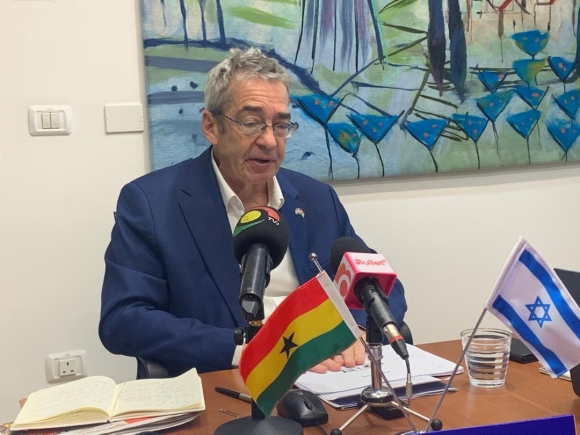
The Ambassador of Israel to Ghana, Roey Gilad, has called on the Ghanaian government to support an international campaign seeking what he described as a strategic change in the administration of Iran.
Speaking at a press conference at the Israeli Embassy in Accra on Wednesday, March 5, 2026, the envoy said Ghana’s diplomatic influence within international organisations made its voice important in global discussions surrounding Iran.
“We call also the government of Ghana to join its voice. Ghana has a very important voice, especially since last year in Africa.
“In the international community, Ghana is an important member of the International Atomic Energy Agency (IAEA), that is dealing with Iran day in and day out. Ghana is an important player at the ECOWAS and AU.
“In all those international fora, we hope that the government of Ghana will join its support for the international campaign that is calling and looking and wishing for a strategic change in the administration in Iran,” he said.
Duration of military operation uncertain
Ambassador Gilad said it remained unclear how long the latest military operation in Iran would last, noting that the situation could persist for several weeks.
“If you ask me how long this second round is going to last, I can't give you an answer. Unfortunately, I'm not very optimistic. I think it's a matter of weeks, but obviously I cannot commit myself.
“Those people in Iran, as I said before, are brutal. They have no intention to give up easily,” he said.
He added that Israel hoped the ongoing joint military action with the United States would ultimately contribute to peace and stability in the Middle East.
The comments come amid rising tensions between Israel and Iran, with hostilities between the two countries reportedly resulting in significant casualties.
Justification for strikes
The ambassador defended the joint US–Israel strikes on Iran, arguing that Tehran’s alleged nuclear ambitions posed a direct threat to Israel and its allies.
“When the intention to destruct the state of Israel meets their capability to do so, this is when we become nervous. This is when we try to preempt the danger.
“If you all remember the campaign, we [US-Israel] had against Iran, we thought we were done. We thought they learned a lesson; but no, so they accelerated the development of a nuclear bomb and of ballistic missiles.
“They also started to dig very deep storages where they can remove those operations from ground level into very deep underground level where we could not reach,” he said.
Ambassador Gilad further stated that the strike and elimination of Iran’s Supreme Leader, Ali Hosseini Khamenei, was intended to prevent Iran from acquiring nuclear weapons, weaken its ballistic missile capabilities and create conditions for political change within the country.
He described the Iranian leadership as a “brutal, autocratic and theocratic regime” and accused it of violently suppressing dissent.
The envoy also alleged that Iran had supported armed groups in the region, including Hamas in Gaza, Hezbollah in Lebanon and the Houthis in Yemen, in attacks against Israel.
Casualties reported on both sides
Ambassador Gilad said the conflict had resulted in casualties on both sides, including the deaths of six Americans during the hostilities.
“As of March 4, 180 missiles hit Israel, and 120 plus unmanned aerial vehicles (UAVs), like a big drone, hit 10 impact sites in Israel. We suffered casualties as 11 Israelis were killed and 120 were injured. We paid a price,” he said.
He noted that Iran had suffered heavier losses, including the deaths of its Supreme Leader, senior military officials such as the commander of the Islamic Revolutionary Guard Corps, Mohammad Pakpour, and security adviser Ali Shamkhani.
Other officials reportedly killed included Mohammad Shirazi, chief of the military bureau of the Supreme Leader; Saleh Asadi, head of intelligence at the Khatem Alanbieh Command; and senior defence officials Hossein Jabal Amelion and Reza Mozaffari-Nia.
According to the ambassador, the military campaign — codenamed “Rising Lion” and “Roaring” — targeted key elements of Iran’s leadership and security structure.
He said Israel’s civilian population remained resilient despite the attacks, stressing that many Israelis believed decisive action was necessary to address what they view as a long-standing security threat from Iran.
