
Let’s seek lasting solution to the Tuareg problem
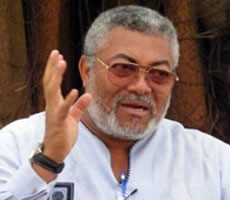
Former President Jerry John Rawlings has called on the African Union (AU) to find a lasting political solution to the Tuareg issue in Mali.
He cautioned that in seeking to bring some order and political authority across Mali, there was need not to assume that military force will stifle the grievances of the Tuaregs.
It would be recalled that ethnic Tuaregs who launched a new rebellion in October 2011 after returning with weapons from Libya, where they had fought for Gaddafi has consistently caused a political instability in Mali until a few weeks ago when French air-targeted strike left them in disarray in Northern Mali.
In a press statement Mr Rawlings said the intervention by France and ECOWAS in the Mali situation was a welcome one and worthy of commendation but there was the need to look at getting a permanent solution to the problem.
“While ECOWAS, France and members of the international community continue to pool their resources in resolving the unfortunate conflict in Mali I call on the major stakeholders to seriously consider seeking a lasting political solution to the Tuareg issue”.
He said it was general knowledge that the Tuaregs have been seeking an autonomous region in Mali for a considerable period and that while offering them autonomy may not be a logical solution to the problem because of the multi-ethnic and cultural situation in Mali, it is important that serious consideration is given to their grievances with the goal of seeking a lasting solution that satisfies all the people of Mali”, he said.
Mr Rawlings maintained that the non-resolution of some of these ethnic and cultural differences across the continent has given room to terrorist cells infiltrating disillusioned groups, offering them a voice and using them for their selfish and parochial interests.
Africa cannot afford to brush under the carpet unresolved ethnic issues with the potential of metamorphosing into terrorist activity because of the vulnerable situation our local societies find themselves in, he observed.
In seeking support from the international community, the former President said, “we should also be careful we do not export terrorism from one country to another”.
He said taking on the previous Libyan regime, led to the escalation of the Malian problem as heavily armed fighters crossed into Northern Mali.
“We should not resurrect the problem elsewhere by pushing the fighting Tuaregs into neighbouring countries and sowing seeds of fresh conflict with its attendant spiral effect”.
He called for the need to resolve to bring an end to ethnic conflicts that are not uncommon in our various countries and asked the African Union, ECOWAS and other stakeholders to work in concert to bring the aggrieved parties to the negotiating table and ensure that a workable and lasting solution was reached – one that will sustain the stability of Mali and one that will make it difficult for terrorists with ulterior motives to infiltrate ethnic ranks to sow seeds of violence and confusion.
The ethnic Tuaregs launched their new rebellion in October 2011 after returning with weapons from Libya, where they had fought for Gaddafif.
On March 2012, military officers deposed President Amadou Toumani Toure over his handling of rebellion and in April 2012, the Tuareg and Islamist fighters seized control of northern Mali, and declared independence.
In June 2012, the Islamist groups captured Timbuktu, Kidal and Gao from Tuaregs, and started to destroy Muslim shrines that offended their puritan views
The Islamist rebels seized the town of Douentza in September 2012, crossed into central Mali and threatened government-held south.
They caputed the central town of Konna in January this year, which raisied fears they could march on the capital.
President Dioncounda Traore then asked France for help which led to the airstrikes which disperssed the rebels.
