
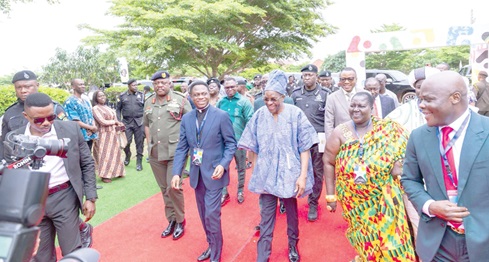
The Church of Pentecost hosted the third edition of the National Development Conference (NADEC) between July 8-10, 2026, at the Pentecost Convention Centre, Gomoa Fetteh.
The conference theme - ‘Moral Vision and National Development’ – brought together representatives of Ghana’s political, judicial, traditional, religious and civil societies to ponder the country’s development trajectory.
Apart from senior religious figures, the NADEC featured high profile political personnel, including the Speaker of Parliament Alban Sumana Kingsford Bagbin; the Minister of Local Government, Chieftaincy and Religious Affairs, Ahmed Ibrahim and Sheikh Armiyawo Shaibu.
Speakers at the conference, who also included the spokesperson for the National Chief Imam, emphasised that national development required a profound reset of character, virtue and ethical values and an urgent and sincere return to moral principles.
Speaker Bagbin urged Ghanaians to raise children who value truth, nurture public servants who place service above self-interest, encourage business leaders to pursue ethical enterprise and support political leaders who put national interest before partisan consideration.
The Minister of Local Government, Chieftaincy and Religious Affairs commended the Church of Pentecost for championing the NADEC initiative, which he stated should ordinarily have been led by the state.
Advocating an urgent and sincere return to moral principles, Sheikh Shaibu emphasised that national development requires a profound reset of character, virtue and ethical values.
Moral vision and good governance: the elusive goal?
NADEC places morality at the centre of Ghana’s development conversation.
While acknowledging the importance of both improved infrastructure and suitable development policies, conference speakers agreed that integrity, accountability, justice, patriotism and responsible leadership are essential for building strong institutions and public trust.
Ethical leadership, responsible citizenship and shared national values are believed crucial to build a prosperous, peaceful and resilient Ghana.
Barriers to good governance
Many would agree that good governance is more crucial than moral vision for sustained national development.
While a moral vision can provide both intent and direction, unremitting good governance is necessary for appropriate structural execution.
Put another way, without transparency, the rule of law and institutional capacity, even the most righteous of moral visions fails to translate into crucial building blocks of national development: sustainable economic and social progress.
Present political leadership
Ghana’s leaders exhibit a mixed and deeply contested record regarding integrity, accountability, justice, patriotism and responsible leadership.
While the Fourth Republic is characterised by a strong constitutional framework, a democratic transition, regular relatively trouble-free general elections and institutional rhetoric highlighting the importance of those in power using it for the common good, everyday governance remains severely constrained by systemic corruption and political self-interest.
Governments in Ghana successfully maintain national democratic stability and help sustain regional peace.
Yet, the country’s governance is deeply undermined by severe deficits in integrity, accountability and many would say, genuine patriotism.
There is rampant and systemic public-sector corruption, evidenced by stagnant international anti-corruption scores, as well as regular financial irregularities that are rarely prosecuted due to political interference in the justice system.
The prevailing political culture prioritises partisan loyalty and elite self-enrichment over national progress, leaving a stark gap between the country’s strong constitutional ideals and the actual practice of responsible long-term leadership.
The way forward
What is the role of moral vision in helping deliver real development in Ghana?
NADEC works from the premise that a nation cannot sustain structural or economic development if its civic and moral fabric collapses.
Transforming the individuals who populate state institutions is deemed crucial to building a national foundation capable of resolving long-standing governance issues.
Ghana’s persistent development failures are not merely the result of flawed macroeconomic policies, but are said by speakers at NADEC to be deeply rooted in a systemic collapse of the nation’s civic and moral fabric.
Because political polarisation, public sector corruption and unaccountable leadership have rendered traditional state governance structures seemingly intractable, Ghana needs more than abstract developmental theories to succeed.
National progression is continuously thwarted by institutionalised dishonesty, lack of professional accountability, and, for millions of Ghanaians, severe structural gaps in basic amenities such as clean water, employment and food security.
NADEC seeks to highlight these vulnerabilities by warning that material and economic growth cannot be sustained without a foundational revolution in individual character, thereby shifting the responsibility of national development from distant political promises directly to the ethical integrity of citizens and public officials in the marketplace.
The writer is Emeritus Professor of Politics, London Metropolitan University, UK
