
When is it appropriate for religious figures to ‘talk politics’?
When the issue surfaced in the mid-1980s, during the closing years of the Provisional National Defence Council (PNDC) era, the debate centred on the question of when the PNDC would steer the country back to constitutional government.
The church was in the forefront of popular demands for democracy, improved human rights and protection of religious freedoms. Initially dismissive of the church’s demands, over time, the latter won the day: Ghana redemocratised in 1992 to usher in the Fourth Republic.
Is church getting political?
Fast forward four decades and the issue is no longer about democracy: both church and successive governments are prominent supporters of democracy.
The issue now is illegal gold mining – galamsey.
The church’s public concern about the catastrophic effects of galamsey is regarded by some members of the ruling party to be inappropriate: it crosses a boundary and turns the church into a political animal and this is not acceptable.
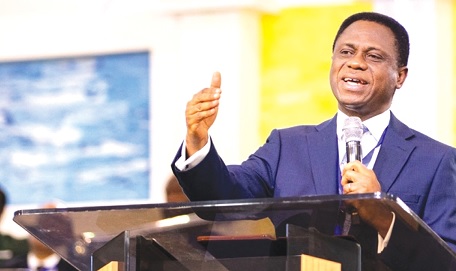
The furore began when Apostle Dr Eric Nyamekye, the Church of Pentecost’s 6th Chairman, commented on the country’s engagement with galamsey.
His recent statement regarding the undesirability of river baptism in Ghana’s increasingly polluted river waters, especially in gold mining areas, focused attention on the prominent role of the church in relation to controversial issues in the country’s development.
Flames of Controversy
The flames of controversy were then fanned by Dr Mary Awusi, Chief Executive Officer of the Ghana Free Zones Authority.
Dr Awusi publicly lambasted Apostle Dr Eric Nyamekye for his comments about the failure of the government to tackle galamsey with the seriousness it undoubtedly deserves.
She stated: ‘He’s a man of God, so we’ll forgive him. But next time, he shouldn’t stoop so low to that level.
I am telling him. If he descends to that level to behave like a politician, we will deal with him as a politician. I’ve given him reverence because he’s a man of God and the Chairman of the Church of Pentecost’.
So, when a senior member of the church comments on an environmental catastrophe he is behaving ‘as a politician’ and, if it happens again, Dr Awusi would ‘deal with him as a politician’. It is not clear what she meant by the last comment but clearly it was not intended as a compliment.
The former Moderator of the Presbyterian Church of Ghana, Rev. J.O.Y. Mante, leapt to Apostle Dr Nyamekye’s defence, warning Dr Awusi, ‘not to allow her eyes to go above her eyebrows’.
In other words, she should stay humble, respect the social hierarchy, know her place and show humility and restraint in responding to church criticisms about the government’s ineffectiveness to quell galamsey.
Speaking on the theme of unity at the Victory Presbyterian Church Fafraha, Rev. Mante stressed that it is inappropriate for a public official such as Dr Awusi to caution or threaten individuals simply for expressing concerns about the destructive impact of galamsey on the nation.
He further declared that the church and its leaders would not be intimidated.
Moral
Then the Roman Catholic Church got involved. The President of The Ghana Catholic Bishops’ Conference, Matthew Kwasi Gyamfi, defended the church’s involvement in national issues, stating that its role in public discourse is a moral duty and not political activism.
Bishop Gyamfi stated the church had a responsibility to speak on matters affecting society, especially issues that touch on human dignity, justice and the environment.
He stressed that the church cannot remain quiet in the face of ‘moral and social concerns.
When issues arise that threaten human dignity, the integrity of creation or the common good—such as the grave harm caused by illegal mining—the Church has both the right and the duty to speak.
This is not partisan politics; it is a moral responsibility rooted in the Gospel’.
What happens next?
Ghana’s return to democracy in 1992 was in the context of a secular Constitution.
Religious leaders – both as individuals and as senior figures in a prominent civil organisation – have a constitutional right to comment on national issues of importance. But there is an unwritten rule that they must not be politically partisan.
As a result, church leaders are very adept at not publicly supporting one of the ‘Big Two’ political parties.
I have been observing politics in Ghana for four decades.
The current controversy about galamsey – and by extension the ‘right’ of the church to get involved in ‘political’ issues – is, I think, the most serious since the PNDC era.
Then, the government was outwitted and defeated by a coalition of civil society organisations, led by the church, and eventually was compelled by popular demand to reinstate democracy.
The issue now is about galamsey, which many regard as the most serious catastrophe facing the nation.
Will pressure from the church, assisted by civil society, lead to more effective government policies to combat it?
The writer is an Emeritus Professor of Politics, London Metropolitan University, UK.
