
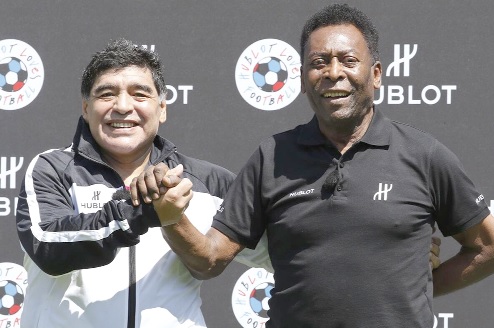
From the award's creation in 1956 through to 1994, the Ballon d'Or was not a global prize. It was the European Footballer of the Year, and France Football restricted eligibility strictly to players holding European nationality.
The limitation was not a matter of bias in the voting room; it was a formal condition of entry.
For Pelé, there was simply no way in. Born in Brazil, he spent his career at Santos and later the New York Cosmos, meaning he failed the nationality requirement and the club requirement simultaneously.
Three World Cup medals and a 1970 tournament many consider the finest in history, and he never once appeared on a ballot.
Maradona's situation cuts a little deeper.
He spent the heart of his career in European football, at Barcelona from 1982 to 1984, then Napoli from 1984 to 1991, and briefly at Sevilla from 1992 to 1993.
Any club-based requirement he would have met with ease. What blocked him was his Argentine passport, and nothing else.
That makes 1986 the single most glaring omission in the award's history. Maradona's World Cup campaign in Mexico that year is routinely described as the greatest individual tournament performance the sport has ever seen.
He was ineligible for that year's Ballon d'Or, which went instead to Igor Belanov of Dynamo Kyiv.
Change to Ballon d'Or rules
The eligibility rules were eventually updated, though not quickly enough for either man. In 1995, the award was opened to players of any nationality competing at European clubs, and George Weah became the first non-European to win it.
A further change in 2007 extended eligibility to professionals anywhere in the world.
By then, Pelé had been retired since 1977. Maradona had left European football in 1993 and returned to Boca Juniors, where he played out the final years of his career before retiring in 1997.
How Pele and Maradona were honoured
France Football's response came through one of the rarest trophies in world football. The Ballon d'Or d'Honneur has been awarded only twice across more than seven decades of the prize's existence, and the two recipients are precisely the players the eligibility rules had kept out.
Maradona received his in 1995, the same year the nationality restriction was finally lifted. Pelé was honoured in 2013 at the FIFA Ballon d'Or gala with the Ballon d'Or Prix d'Honneur.
The awards were a formal acknowledgement that the rules, not the voters, had produced an absurd result for two of the sport's defining figures.
Between them, Pelé and Diego Maradona produced three World Cup triumphs, countless iconic moments, and careers that football fans still argue about decades later. And yet, combined, they hold exactly zero Ballon d'Ors.
Updated Ballon d'Or 2026 rankings
We also highlighted facts about the 2026 Ballon d’Or rankings following the announcement of the 30 nominees.
This examines the leading contenders, including Harry Kane, Lamine Yamal, Ousmane Dembélé, Kylian Mbappé and Lionel Messi..
