
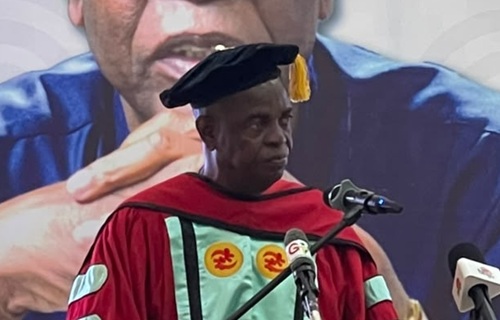
Veteran journalist and Pan-Africanist, Kwesi Pratt Jnr, has observed that Dr Kwame Nkrumah’s Pan-Africanism was not merely about cultural solidarity among Africans, but a political, economic and strategic project aimed at giving the continent the collective strength to determine its own future.
He said the continued fragmentation of Africa made Nkrumah’s argument about continental unity relevant to the continent’s contemporary development aspirations.
Delivering the second part of the 15th Kwame Nkrumah Memorial Lectures — in honour of Ghana’s first President — at the University of Cape Coast (UCC) last Friday, Mr Pratt said Africa’s numerous national markets, currencies, defence structures and competing economic interests could limit the continent’s bargaining power, particularly when individual countries negotiated separately with stronger external powers.
The lecture was on the theme: “Kwame Nkrumah, Yesterday, Today and Tomorrow: Perspectives on Constitutionalism, Development and Pan-Africanism”.
Mr Pratt acknowledged, however, that Nkrumah’s proposal for immediate political union also raised questions about national sovereignty, democratic accountability and how a continental government would respond to Africa’s political and cultural diversity.
He said those questions should form part of the contemporary debate on African integration rather than being used to dismiss the broader argument for unity.
He added that the central lesson from Nkrumah was that political freedom, economic development and African unity were interconnected.
Mr Pratt, who is the Managing Editor of the Insight newspaper, said Nkrumah’s project should, therefore, not be reduced to monuments, speeches or annual commemorations, but examined in relation to the continent’s continuing struggle to achieve economic sovereignty and collective power.
The 15th Kwame Nkrumah Memorial Lectures were a discussion on constitutionalism, development and Pan-Africanism, with Mr Pratt urging the current generation to examine both Nkrumah’s achievements and the unfinished aspects of his vision.
Colonial borders
Mr Pratt said the borders inherited from colonial rule had created African states that often lacked the economic and strategic scale to compete effectively in the international system.
He said the division of the continent was rooted in decisions made by European powers during the colonial era, with Africans having little or no role in determining the boundaries that eventually became the borders of independent African states.
“The African states we have today were not created by us,” he said, adding that the colonial boundaries continued to shape the lives and economic activities of communities living along African borders.
He cited communities along the Ghana-Togo border where, according to him, families and farmers sometimes lived or worked across the two countries.
“This is the African reality, and it is not just on the Ghana-Togo border. It is everywhere,” he said.
Mr Pratt, therefore, called for a deliberate effort to address the divisions created by colonialism in order to pursue the vision of a united Africa capable of controlling its resources and determining its own destiny.
Beyond ceremonial Pan-Africanism
Mr Pratt said the challenge for Africa today was to move Pan-Africanism beyond speeches, ceremonies and symbolic solidarity.
He called for deeper cooperation in trade, industrialisation, transportation, technology, security, climate change, migration and common political strategy.
He said Africa needed to build the capacity to process its own raw materials, connect its economies, and negotiate collectively with powerful countries and institutions.
“A Ghana confined to exporting cocoa, gold and timber could not be fully sovereign,” he said.
The African Union, he said, had similarly linked continental integration with economic emancipation, and indicated that Nkrumah advocated a common economic and industrial programme, including a common market and monetary arrangements.
Mr Pratt also argued that Nkrumah’s approach to non-violence and armed liberation should be understood in the context of the conditions under which different struggles took place.
He said non-violent political action was appropriate to the Gold Coast’s independence struggle, while Ghana’s support for liberation movements after independence reflected the different circumstances confronting territories still under colonial or minority rule.
Independence beyond the flag
Mr Pratt traced Nkrumah’s political formation to his experiences in the United States and Britain, where he encountered racism, Pan-Africanist thoughts, anti-colonial movements and political organising.
He said Nkrumah’s exposure to the African diaspora and the intellectual traditions of Black resistance shaped his understanding that the struggles of Africans on the continent were connected to those of Africans in the diaspora.
He said Nkrumah later participated in the Fifth Pan-African Congress in Manchester in 1945, which helped to strengthen the idea of organised African resistance to colonial rule.
Mr Pratt said when Nkrumah returned to the Gold Coast in 1947, he brought with him an understanding of colonialism as part of a wider international system rather than simply a local dispute between Africans and the colonial administration.
Nkrumah’s formation of the Convention People's Party in 1949, Mr Pratt said, gave organisational expression to the demand for immediate self-government, and took the independence struggle into communities through political education, newspapers, rallies, party branches and relationships with organised labour.
The unity question
Mr Pratt said the question of how Africa should unite became particularly important around the formation of the Organisation of African Unity (OAU) in 1963.
He explained that Nkrumah and other leaders associated with the Casablanca group advocated a more immediate form of political integration, while other African leaders favoured gradual cooperation among sovereign states.
He said the African Union had records that the Casablanca group supported political unity and continental integration, while the Monrovia group favoured a more gradual approach.
Mr Pratt said the disagreement was, therefore, not fundamentally about whether African countries should cooperate, but about how far and how quickly that cooperation should go.
He added that the OAU was eventually established in Addis Ababa in May 1963 by 32 independent African states, with founding objectives that included promoting African unity and solidarity, defending the sovereignty and independence of member states, eradicating colonialism and coordinating cooperation in areas such as economic development, transport, communication, science, technology and defence.
Mr Pratt said Nkrumah welcomed the creation of the continental organisation but believed it did not go far enough towards the political union he envisaged.
