
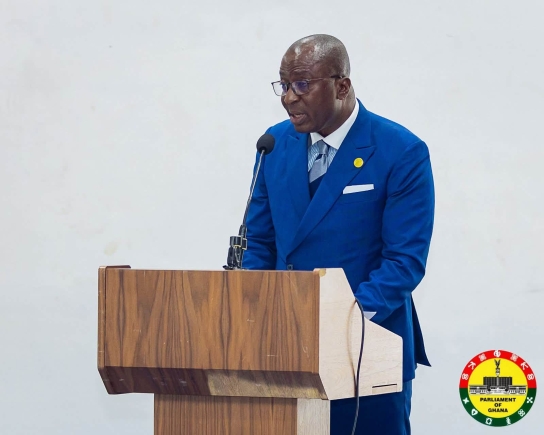
The Speaker of Ghana’s Parliament, Alban Sumana Kingsford Bagbin, has called for the progressive introduction of direct elections for members of ECOWAS Parliament to deepen democratic participation and strengthen regional integration.
He said the future of the West African integration project must be anchored in greater participation by citizens, including giving them a direct role in choosing their representatives at the regional level.
Giving citizens a voice
In an address read on his behalf by the Second Deputy Speaker of Parliament, Andrew Amoako Asiamah, at the joint Second Parliamentary Seminar and Second Extraordinary Session of the ECOWAS Parliament in Accra on Monday (Sept 21), Mr Bagbin said allowing citizens across the sub-region to elect their representatives would “strengthen the regional legislature’s democratic legitimacy”.
“Allowing our citizens to elect their own representatives will not only enhance our effort to bolster regional integration but also ensure the concerns of citizens are effectively represented at the regional level,” he said.
The week-long programme is being held on the theme: “Climate change, environmental degradation, population displacement and growing insecurity in the ECOWAS Region.”
Climate change and insecurity
Mr Asiamah said the theme was particularly timely as West Africa continued to confront interconnected environmental, economic and security challenges.
He said climate change was disrupting weather patterns, intensifying floods and droughts and increasing pressure on natural resources, while deforestation, pollution, environmental degradation and the unsustainable exploitation of natural resources were weakening livelihoods and communities’ capacity to withstand shocks.
He identified illegal small-scale mining, popularly known as galamsey, as one of the most serious environmental threats confronting the sub-region.
He explained that galamsey had contributed to water contamination, deforestation, habitat destruction, soil erosion, air pollution and biodiversity loss, while also creating health risks for affected communities.
“These challenges threaten not only the environment but economic security and quality of life, and are best understood as mutually reinforcing phenomena demanding an integrated response,” he said.
The Second Deputy Speaker further warned that the growing insecurity in West Africa could no longer be viewed solely through the traditional security lens.
He said security must increasingly encompass human security, including the protection of livelihoods, food systems and the environment.
Collective climate action
The Speaker of the ECOWAS Parliament, Hadja Memounatou Ibrahima, also called on lawmakers across the sub-region to renew their commitment to tackling climate change and its growing impact on communities.
She said the increasing incidence of flooding, heat waves and rising sea levels required collective action by legislators and other stakeholders.
Mrs Ibrahima said the effects of climate change had moved beyond data and projections and were now directly affecting livelihoods, communities and regional security.
“Climate disruption can no longer be measured only in degrees, statistics or projections. It is read in land that yields less, in coastlines that retreat, in flooded neighbourhoods, in families losing their livelihoods, and in communities forced to relocate,” she said.
Parliament’s role
The Leader of Ghana’s delegation to the ECOWAS Parliament, George Kwaku Ricketts-Hagan, said the joint events provided an important platform for members to deliberate on issues of common concern and strengthen the parliamentary dimension of the regional integration process.
He said parliamentarians occupied a unique position within democratic systems across the sub-region and had an indispensable role in advancing good governance and regional cooperation.
“We are not only legislators but also representatives of the people and important actors in promoting dialogue, accountability, good governance, peaceful resolution of differences and positive socio-economic and environmental development of our respective countries and the West Africa sub-region in general,” he said.
Mr Ricketts-Hagan said the ECOWAS Parliament had a critical responsibility to bring the voices, aspirations and concerns of citizens closer to the regional decision-making process.
He said that responsibility had become even more significant as West Africa confronted challenges that transcended national borders and could not be effectively addressed by individual countries acting alone.
