
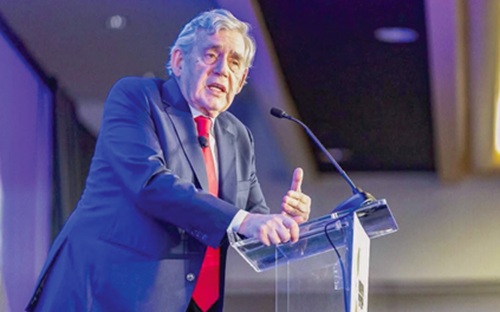
Former British Prime Minister, Gordon Brown, has lauded the Accra Reset Initiative championed by President John Dramani Mahama, describing it as a decisive shift from external dependence to local independence in health governance.
Speaking at the Accra Reset Conference on the sidelines of the 81st UN General Assembly in New York last Monday, Mr Brown said the Reset represented a break from donor-driven systems that denied the Global South control over its own health destiny.
"Country-born healthcare systems, Country-led healthcare systems, local initiatives led by local people making local decisions.
“Never again for external dependence, but independence.
Never again for external control, but local control," he said.
Mr Brown observed that the 2020s were being defined by multiple crises, including atrocities in Gaza, Ukraine and Sudan, the erosion of the rules-based order, unregulated artificial intelligence, nuclear proliferation, and falling humanitarian aid at a time of rising need.
"If the 2020s are to be defined by the end of a rules-based order and the beginning of a non-trade power-based order, if the 2020s are to be defined by AI out of control, nuclear weapons out of control, humanitarian aid falling at a time when the need is rising, then we must do things differently," he said.
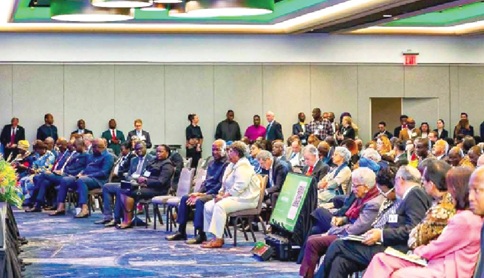
The audience
He said the world must lay down new principles of cooperation to guide future engagement.
Mr Brown disclosed that 100 global leaders had signed a declaration calling on countries to agree on principles of cooperation, backed by a poll of 100,000 people in 34 countries conducted over two years, which asserted that cooperation and persuasion were the way forward and not coercion.
The UN Secretary-General, Antonio Guiteres, in a statement delivered on his behalf by his deputy, Amina J. Mohammed, affirmed that public finance must remain at the centre of efforts to reform global health architecture and sustain gains beyond 2030.
The Secretary-General said while discussions about the post-2030 agenda had begun, the world still had four years to deliver on promises made in 2015.
"In July, we adopted the road map to 2030. It's important because most are talking about beyond 2030. We still have four years to go. And many different ways of trying to get to the promises we made in 2015 still exist," he said.
Mr Guiteres said the release of the principal report by the Panel on Global Health Architecture was critical, stressing that Spain had joined as a founding Northern Co-Steward and that work was advancing on stronger negotiating capacity.
He affirmed that economies must grow to enable inclusive service delivery for health and education, adding that the international financial architecture must create opportunities for investments to flow to countries.
Mr Guiteres further called for intergenerational conversations on opportunities presented by Artificial Intelligence with necessary safeguards and checks and balances.
Changing world
A former President of Nigeria, Olusegun Obasanjo, called for a contemporary shift in the Global South initiatives to meet new changes.
He said Africa must adapt its strategies to match the new reality, adding "what we have to do now is to change, because we have a different world today as compared to the world we had from the establishment of the UN."
"If the drumbeat is changing, the dancing steps must also change. The drumbeat is changing as far as development, finance, infrastructure for development in the Global South, therefore, our dancing steps must also change," the former President added.
He paid tribute to allies who supported the Reset initiative from inception, singling out Mr Gordon Brown and President John Dramani Mahama.
