
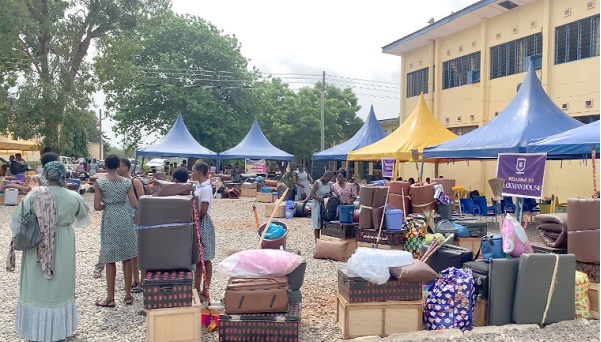
The Ghana Education Service (GES) is investigating some senior high schools over complaints that parents are being compelled to buy items listed in the school prospectus directly from the schools.
The GES Public Relations Officer, Mr Daniel Fenyi, made this known during an interview on Woezor TV on Tuesday, September 22, 2026.
He said the issue was not whether schools could sell items to parents, but whether parents were being forced to buy them from the schools instead of sourcing them from suppliers of their choice.
Mr Fenyi said the release of the National Harmonised Prospectus for the 2026/2027 academic year did not authorise school heads to require parents to purchase items directly from their schools.
He said parents were free to buy the required items from the open market, while schools could provide clarification where a requirement was specific to a particular school.
“The answer is that because of financial constraints, they want the cheaper side,” he said, explaining that some parents had complained that items sold by schools were more expensive than those available on the open market.
“Allow them, let them go to the open market,” he added.
Investigations
Mr Fenyi said some schools were already “under our radar” and that investigations were ongoing.
He said the GES first conducted background checks and engaged the schools concerned, with warnings or instructions to stop the practice where necessary.
He said stronger action could follow if a school head persisted.
“If we observe some persistence, that's where the government or the Ghana Education Service is forced or compelled to remove such a leader from the school,” he said.
Mr Fenyi said a head could sell an item but could not make the purchase compulsory.
“If you, as the head teacher, you are going to sell the items, then you are not going to impose on the parent,” he said.
He said where a school head chose to sell an item, parents should be told they could also obtain it elsewhere instead of being made to treat the school as the only source.
The distinction comes against the background of the National Harmonised Prospectus, which requires parents and students to provide specified items.
The prospectus, released by the GES on September 3, 2026, covers both boarding and day students and sets out requirements for the 2026/2027 admission process.
Among the listed requirements for boarding students are school-specific footwear and socks, checked dresses where applicable, specified shoe colours and belts, as well as items for school use, including cleaning materials.
Mr Fenyi said the inclusion of those items in the prospectus did not mean parents had to buy them from the school.
Parents free to choose
Mr Fenyi said most of the items listed in the harmonised prospectus were available on the open market.
He said schools could tell parents whether their institution required blue, yellow, green or another colour of check, or whether the school required brown rather than black shoes.
Such clarification, he said, should not become an instruction for parents to purchase the items from the school.
He said the GES had received complaints from parents who were not necessarily objecting to buying the items but were concerned about the prices charged by some schools.
“For some of the parents, their worry was even really where they are buying the items from. Their worry was on the pricing of the items,” he said.
He added that some parents preferred to buy directly from the open market because of financial constraints.
Directive
The interview came days after the GES issued directives following complaints about compulsory purchases and the rejection of some items brought to school by students.
In a directive dated September 18, 2026, the GES said it had received reports that some schools were turning away newly admitted boarding students or refusing to accommodate them because of the type of trunk, chop box or other personal storage container they brought to school.
The Service directed schools not to deny accommodation to duly admitted students solely because of the type of storage container they brought, provided the item was reasonably sized, safe and did not pose a risk to other students.
It also directed that reported cases be investigated and submitted to management.
The directive followed the release of the harmonised prospectus, which lists a hard-body suitcase or trunk/chop box among the items required for boarding students.
The GES position is that parents and students are required to provide the items listed in the prospectus, but schools should not use their control over admission or boarding accommodation to force parents to buy particular items, brands or types from the school.
Uniform concerns
The interview also brought to light concerns over delays in the supply of school uniforms.
The National Vice-President of the Conference of Heads of Assisted Secondary Schools (CHASS), Togbe Foe Tsali, said some second-year students were still wearing checks because their school uniforms had not been supplied.
He questioned the practicality of students relying on one check throughout the school week and called for the government-supplied uniforms to be made available before students arrived on campus.
He also suggested that schools should be allowed to keep a small number of spare uniforms for students whose parents were unable to provide the required clothing because of financial difficulties.
Mr Fenyi acknowledged that there had been delays in supplying uniforms to some schools, particularly for second-year students, but said distribution had begun and some schools had already received their supplies.
No child should stay home
Mr Fenyi said the broader concern for the GES was to ensure that a child's access to education was not affected by a parent's inability to pay for an item.
He said no child should remain at home because a parent could not afford a uniform, table, chair, personal protective equipment or another requirement.
He said the GES had therefore sent strong messages to school heads against conducting school business in a manner that could prevent children from attending classes.
Togbe Foe Tsali, while acknowledging the explanation from the GES, urged heads to follow the approved guidelines during the ongoing admission process.
He said heads should not allow any child to stay out of school because a parent could not pay for an item demanded by the school.
The General Secretary of the National PTA Council, Mr Raphael Kofi Gapson, also called for stronger engagement among the GES, school authorities and parents to prevent misunderstandings over admission requirements.
