

Two speakers at the Graphic Business/Stanbic Bank Breakfast Meeting have called for collaboration among businesses to make cross-border payments faster, cheaper and more predictable.
They said the collaboration should focus on reducing payment delays, simplifying documentation and improving access to foreign exchange.
The meeting, held in Accra yesterday, brought together stakeholders from the banking and business sectors to examine how payment infrastructure, foreign exchange, regulation and compliance could be improved to make cross-border trade easier for businesses.
The Head of Corporate and Investment Banking at Stanbic Bank Ghana, Musah Abdallah, and the Sustainability Manager of Miniplast Ltd, Dr Paa Kwesi Eduaful Abaidoo, spoke on the theme: “Moving Money.
Moving Trade. Moving Ghana: Making it easier to sell, buy and pay across borders".
They stressed that collaboration would help businesses to reduce transaction costs, manage foreign exchange risks and trade more competitively.
Mr Abdallah said banks and businesses could work together to simplify documentation, digitise the submission of supporting documents and identify suitable payment channels for different markets.
He explained that such an approach would enable financial institutions to design payment solutions around how businesses actually operated, rather than expecting businesses to navigate complex processes on their own.
"Banks should move beyond simply providing financial products and work with businesses to understand their ecosystems and develop solutions that support their long-term survival and growth," Mr Abdallah said.
He also said the progress made through initiatives such as the African Continental Free Trade Area (AfCFTA) and new payment systems provided a foundation for easier trade across the continent.
"However, more work and collaboration is required to make the systems easier for businesses to use," he said.
New routes
Mr Abdallah said payment systems such as the Cross-Border Interbank Payment System (CIPS) for China-related transactions and the Pan-African Payment and Settlement System (PAPSS) for intra-African trade could help businesses overcome some of the delays, costs and uncertainties associated with international payments.
CIPS, an initiative powered by Stanbic Bank, provides a more direct payment route for eligible Chinese yuan transactions between Ghana and China.
The system is particularly relevant to Ghanaian businesses importing from China, where payment may otherwise pass through several intermediaries.
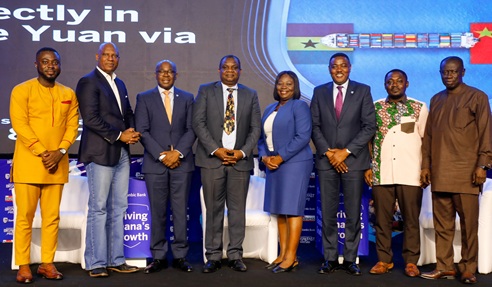
Ato Afful (2nd from left), Managing Director, Graphic Communications Group Ltd, with Kwamina Asomaning (3rd from left), Chief Executive of Stanbic Bank Ghana; Musah Abdallah (3rd from right), Dr Paa Kwesi Eduaful Abaidoo (2nd from right), Sustainability Manager, Miniplast LTD; and some dignitaries after the Graphic/Stanbic Bank Breakfast Meeting. Picture: ELVIS NII NOI DOWUONA
CIPS operates as an additional route for eligible transactions rather than a replacement for the Society for Worldwide Interbank Financial Telecommunication (SWIFT) system.
For trade within Africa, PAPSS offers another route by allowing participating businesses to make payments in local currencies, reducing the need for multiple currency conversions and reliance on correspondent banks.
Impact
For his part, the Sustainability Manager of Miniplast Ltd, Dr Paa Kwesi Eduaful Abaidoo, said simplifying the payment process could have a direct impact on business performance.
“If we can process the payment faster, cheaper and more predictable for a business, be it in Makola or be it in Thailand, we will not only move money.
We will move trade and help grow Ghana,” he said.
He said payment delays could create uncertainty for both buyers and suppliers.
Hence, a supplier who did not receive payment on time could incur additional costs or delay production, with the effects eventually reaching the buyer and consumer.
Dr Abaidoo added that businesses could upload supporting documents electronically instead of physically submitting them, making the process more seamless.
