


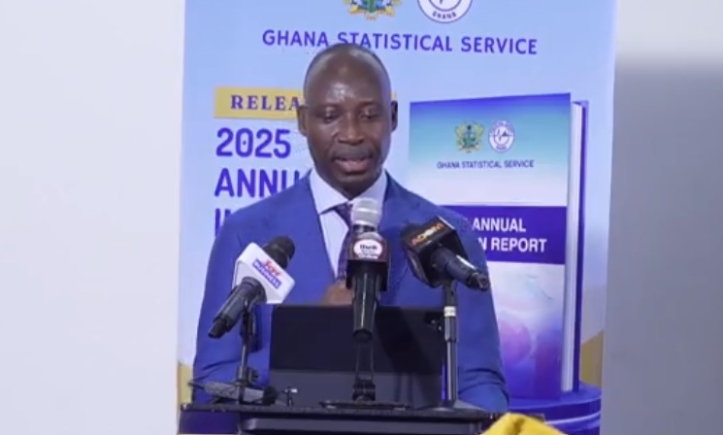
Ghana’s inflation performance in 2025 showed marked improvement, with the annual average rate declining significantly, but the cost of living remains elevated and continues to weigh heavily on households, the Government Statistician, Dr Alhassan Iddrisu, has said.
Speaking at the launch of the Ghana Statistical Service’s (GSS) maiden Annual Inflation Report in Accra, Dr Iddrisu described the development as “real progress”, while cautioning that the pace of price increases had merely slowed rather than reversed.
He explained that the new report represents a shift from the routine publication of monthly inflation figures to a more comprehensive analysis that examines the underlying drivers of price changes and their broader economic impact.
“Inflation is not just a number; it reflects the reality of everyday life. It determines whether a worker’s salary can feed a family, whether businesses can plan with confidence, and whether government policies are working to improve people’s lives,” he said.
Twelve months of decline but prices still elevated
According to the report, inflation declined steadily over the course of 2025, recording 12 consecutive months of reduction. The annual average inflation rate fell to 14.6 per cent, down from 22.9 per cent in 2024, reflecting a significant easing of price pressures.
However, Dr Iddrisu was quick to point out that the improvement does not translate into lower prices for consumers.
“Lower inflation does not mean lower prices. Prices are still high; they are simply rising more slowly,” he noted.
He added that although the downward trend offers some relief, many households are still grappling with the lingering effects of previously high inflation.
Food prices dominate inflation drivers
The report identifies food as the single largest contributor to inflation, accounting for more than half of the overall rate, underscoring the central role of food costs in shaping household expenditure patterns.
Dr Iddrisu further disclosed that nearly three-quarters of inflation in 2025 was driven by locally produced goods, indicating that inflationary pressures were largely domestic rather than imported.
Goods, particularly essential items such as food, fuel and housing, accounted for close to 80 per cent of total inflation, highlighting the extent to which everyday necessities continue to influence price dynamics.
Regional disparities highlight policy gaps
The report also revealed significant regional variations in inflation rates, with the Upper West Region recording the highest average inflation of 24.9 per cent, while the Bono East Region registered the lowest at 10.9 per cent.
“These differences matter because policies that work in Accra may not necessarily work in Wa,” Dr Iddrisu noted, stressing the need for more targeted, location-specific policy interventions.
Sustaining gains will be more challenging
While acknowledging that lower inflation improves planning conditions for businesses and offers some relief to households, the Government Statistician warned that maintaining price stability would require sustained policy discipline and coordination.
He emphasised that reducing inflation was only part of the challenge, noting that keeping it low over time would be even more difficult.
The report outlines key policy priorities, including strengthening food systems, maintaining fiscal and monetary coordination, addressing regional disparities, boosting domestic production and enhancing data systems for informed decision-making.
Dr Iddrisu urged policymakers, businesses and the public to make effective use of data in shaping decisions, stressing that evidence-based policy remains central to achieving sustainable economic stability and long-term development.