
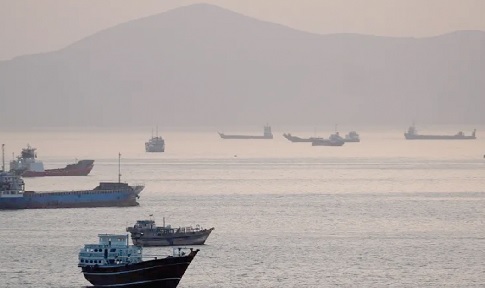
The Strait of Hormuz is the only maritime route from the Persian Gulf to the ocean, making it one of the most critical choke points for the movement of energy resources from this region.
The Strait of Hormuz is a roughly 104-mile-long waterway that narrows to about 24 miles at its tightest point. It connects the Persian Gulf to the Gulf of Oman and serves as the only passage to the open seas.
The strait is bordered by Iran to the north and the Musandam Peninsula shared by Oman and the United Arab Emirates to the South.
Global oil trade
Roughly 20 per cent of the world’s liquefied natural gas and global oil trade passes through this waterway each year.
Of the roughly 20 to 21 million barrels of oil that transited the strait daily in 2025, more than 80 per cent goes to Asian markets, with China being the most dependent on it.
Unlike other choke points, there are few viable alternatives for exporting energy from the Persian Gulf, making the Strait of Hormuz essential for oil and gas shipments.
Bounded to the north by Iran and to the south by Oman and the United Arab Emirates (UAE), the corridor - only about 50km (31 miles) wide at its entrance and exit, and about 33km wide at its narrowest point - connects the Gulf with the Arabian Sea.
The strait is deep enough for the world's biggest crude oil tankers, and is used by major Middle Eastern oil and LNG producers, as well as their customers.
About 3,000 ships usually sail through the strait each month, but this dramatically decreased during recent hostilities, with Iran threatening to attack tankers and other ships.
United Nations rules
United Nations rules allow countries to exercise control of territorial seas up to 12 nautical miles (13.8 miles) from their coastline. At the narrowest point, the Strait of Hormuz and its shipping lanes lie entirely within Iran and Oman's territorial waters.
Gulf countries, including Iran, rely heavily on energy exports for their income. Disruption in the Strait has also hit Asia hard, with China alone estimated to buy around 90 per cent of the oil that Iran exports to the global market.
In Asia, the fuel crisis continues to impact daily life. Governments have ordered employees to work from home, cut the working week, declared national holidays and closed universities early in order to conserve their supplies.
In Africa, South Sudan and Mauritius both announced measures restricting electricity consumption. In Europe, Slovenia became the first EU member state to implement fuel rationing.
About 20 million barrels
In 2025, about 20 million barrels of oil and oil products passed through the Strait of Hormuz per day, according to estimates from the US Energy Information Administration (EIA).
That is nearly $600bn (£447bn) worth of energy trade per year. The oil comes not only from Iran but also from other Gulf states such as Iraq, Kuwait, Qatar, Saudi Arabia and the UAE.
Hormuz is also a crucial route for exports of fertiliser from the Middle East, where natural gas is used heavily in the production process. About one-third of the world's fertiliser trade normally passes through the Strait.
The strait is also a vital channel for imports to the Middle East, including food, medicines and technological supplies.
Irans territorial waters
Because Iran controls part of the strait through its territorial waters, it can influence and disrupt shipping, including targeting vessels it considers a threat.
In 1959, Iran expanded its territorial waters to 12 nautical miles into the strait, and Oman followed in 1972. Because the strait is so narrow, their territorial waters now overlap, placing the entire waterway within their jurisdiction. However, under international law, ships retained the right of transit passage, so the strait remained open to global shipping.
After the United States and Israel carried out air strikes on February 28, Iran retaliated with missile and drone strikes against US and Israeli interests in the region.
Shortly thereafter, Iran escalated tensions further by threatening commercial shipping, launching drone attacks and deploying naval mines to disrupt traffic through the Strait of Hormuz.
Hundreds of tanker ships are idled near the strait.
The number of vessels passing through the strait (around 100 ships per day in February) has dropped by over 90 per cent.
Ceasefire
Iran and the US have agreed to a ceasefire on the condition that "safe passage" through the Strait of Hormuz is guaranteed.
Tehran had effectively blocked the waterway, one of the world's busiest oil shipping channels, since the US and Israel attacked the country on February 28.
About 20 per cent of the world's oil and liquefied natural gas (LNG) usually passes through the strait, and hostilities have sent global fuel prices soaring.
Oil prices plunged by around 15 per cent shortly after the announcement of the ceasefire.
The Strait of Hormuz is one of the world’s most critical maritime chokepoints, carrying around a quarter of global seaborne oil trade and significant volumes of liquefied natural gas and fertilisers.
The ongoing military escalation in the region has disrupted shipping flows through this narrow passage.
The resulting ripple effects go far beyond the region, affecting energy markets, maritime transport and global supply chains.
Developments
These developments raise concerns for global trade and development prospects.
Oil markets have reacted quickly, with Brent crude prices now rising above $90 per barrel.
Higher energy, fertiliser and transport costs including freight rates, bunker fuel prices and insurance premiums may increase food costs and intensify cost-of-living pressures, particularly for the most vulnerable.
Socio-economic implications for developing economies: Many developing countries already face high debt service burdens, limited fiscal space and constrained access to finance.
In this context, rising energy, transport and food costs could strain public finances and increase pressure on household budgets, potentially heightening economic and social pressures and complicating progress towards sustainable development, particularly in economies heavily dependent on imported energy, fertilisers and staple foods.
With oil prices surging worldwide, the global economy is feeling the impact as the conflict between Iran, the United States and Israel continues to escalate. The world now waits to see how this crisis will unfold.
