
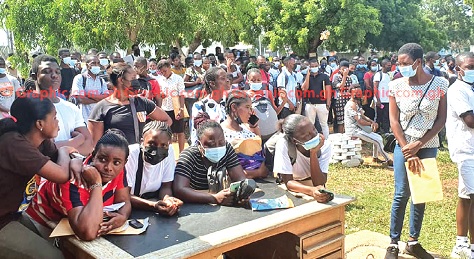
For some time now, recruitment into Ghana's security services has increasingly become a subject of public debate, raising questions about fairness, professionalism, and political influence.
At the heart of this discussion are the positions of the National Democratic Congress (ND) and the New Patriotic Party (NPP), both of which publicly endorse merit-based and regionally inclusive recruitment.
In principle, regional balance is a sound and necessary policy which needs to be encouraged and pursued. It is intended to ensure that all parts of Ghana, particularly less endowed regions, are fairly represented in national security institutions such as the Police Service, Armed Forces, Immigration, Fire Service, and Prisons Service.
The goal is to promote inclusiveness, national cohesion, and equal opportunity for all without discrimination whatsoever.
However, emerging realities and an analysis of the regional balance policy suggest its implementation may be producing unintended results if care is not taken.
Observation
A recent observation during a public transport journey from Sefwi to Accra provides a useful illustration and food for thought.
The VIP bus on which I was, was filled with young applicants, who had travelled from Accra to Sehwi Wiawso, the capital of the Western North Region, to participate in recruitment exercises.
During interaction with some of them, their motivation was the belief that competition in less endowed regions is lower, thereby increasing their chances of success.
This observation only relates to the Western North Region but could be pervasive and cuts across other less endowed and newly created regions of the country.
This growing practice raises a critical concern.
When applicants from more competitive regions move in significant numbers to less competitive ones, they may inadvertently displace indigenes and long-term residents of those areas.
For many local applicants, this feels like a loss of opportunity and displacement in a system that was originally designed to include them. If this trend continues unchecked, the concept of regional balance risks being reduced to a mere formality, one that achieves numerical representation without delivering substantive fairness.
Issue
At the same time, the issue is not without complexity. Ghana is a unitary state, and every citizen has the constitutional right to move freely and pursue opportunities in any region.
With my legal cap on, I know and can say that a rigid "indigene-only" recruitment policy would be difficult to justify legally and could undermine national unity.
The divergence in political perspectives further shapes this debate.
The NDC has consistently called for a restructuring of recruitment processes to eliminate political influence and ensure strict merit-based selection.
It also emphasises fairness and inclusiveness across regions.
The NPP, on the other hand, maintains that existing systems already provide for merit and regional representation, advocating improvements in implementation rather than a complete overhaul.
Yet, beyond partisan positions, the real challenge lies in bridging the gap between policy intent and lived experience.
My suggestion is thus that a more balanced approach is needed - one that preserves national accessibility while protecting the spirit of regional inclusion.
This could involve introducing verifiable background considerations into recruitment, such as evidence of long-term residence in a region, completion of basic or secondary education within the region and community-based verification mechanisms, among others.
Such measures, if adhered to, would not exclude non-indigenes but would help ensure that local populations are not systematically disadvantaged.
Equally important is transparency.
Recruitment authorities must clearly outline how regional quotas are allocated and enforced.
Without this clarity, public confidence in the system will continue to erode, regardless of which political party is in power.
Ultimately, regional balance must be more than a policy slogan.
It must translate into a system that is both nationally open and locally fair.
If citizens begin to perceive that recruitment can be easily navigated or manipulated to their disadvantage, trust in the security institutions themselves may suffer.
Challenge
The challenge for policymakers, whether within the NDC or NPP, is to ensure that a policy designed to unify does not become a source of division.
True fairness lies not just in equal access, but in equitable outcomes that reflect both Ghana's unity and its diversity.
Still, the perception is rife that "Protocol" recruitment by the authorities and those at the helm is widespread.
This practice not only leads to corruption but also favouritism and exclusion and defeatist of the very laudable policy initiative.
The NDC government has promised to completely abolish "protocol" recruitment to nip in the bud the perceived corruption and favouritism associated with recruitment into the security services.
It is hoped that both the NDC and NPP party apparatuses will give the government a free hand to make this workable.
Since both political divides support equal regional representation and diversity across all security agencies, they must allow transparency to prevail in order to court public trust in the system at all times.
The writer is legal manager/company secretary, Graphic Comm. Group Ltd., Accra.
E-mail:
