
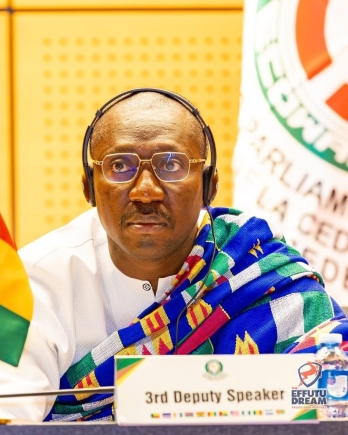
The Minority Leader and Third Deputy Speaker of the ECOWAS Parliament, Alexander Afenyo-Markin, has called on West African states to collectively demand the arrest, prosecution and conviction of South Africans engaged in xenophobic attacks on other African nationals, especially West Africans.
Mr Afenyo-Markin said the South African authorities must go beyond ceremonial speeches and take action to bring the perpetrators to book, stressing that South Africa was liberated by African solidarity, and to repay that with mob violence was a betrayal.
Delivering a statement of public interest on the floor of the ECOWAS Parliament in Abuja, Nigeria, last Tuesday, Mr Afenyo-Markin declared: “South Africa must move from speeches to action.
The South African Police Service, the National Prosecuting Authority and the Independent Police Investigative Directorate must investigate every documented incident.
The perpetrators — many of whose faces are already known from social media — must be identified, arrested, charged and prosecuted without fear or favour .
Not some of them. All of them.”
Statement
The Minority Leader’s statement was on the theme, “West African lives, dignity and the imperative of integration: accountability, justice, free movement and regional solidarity”.
“I am asking this House to transmit a formal Statement of Deep Concern to the South African Parliament, the South African government, the African Union (AU) Commission, and the African Commission on Human and Peoples' Rights, demanding arrests, prosecutions and convictions, and making clear that this Parliament will not accept the routine violation of the dignity and safety of West African nationals anywhere on this continent,” Mr Afenyo-Markin said in a seven-page message, which also drew widespread corroboration and serious commentary from other MPs of the regional bloc’s house of representatives.
The message, which made four other demands, referenced the long list of xenophobic violent incidents in many cities and provinces of South Africa involving Nigerians, Ghanaians, Ethiopians, among others, and the steps Ghana’s Foreign Affairs Minister, Samuel Okudzeto Ablakwa, and his Nigerian counterpart, and the others, had taken to illustrate how deteriorating the latest incidents were becoming.
Mr Afenyo-Markin also drew attention to the public comments of the South African leadership, especially the President, Cyril Ramaphosa, which on one hand appeared to condemn the incidents but on another emboldened the criminal elements to go on the rampage.
“Now, Madam Speaker, I want to address directly the intervention of President Cyril Ramaphosa in his keynote address at the 2026 Freedom Day National Celebrations in Bloemfontein on April 27.
“He said, “We must not allow these concerns to give rise to xenophobia, directed towards people from other African countries or any other parts of the world. Instead, we must insist that the law be upheld and enforced. We will not allow people to take the law into their own hands.'”
Mr Afenyo-Markin also quoted the South African President in the same speech, declaring further that: “'It cannot be, and it must never be, that we trample on the African fellowship that made our freedom possible.'”
He said those were the right words so the ECOWAS Parliament must take President Ramaphosa at his word, stressing that, “words delivered from a ceremonial platform do not arrest a single perpetrator.”
“Condemnations, however eloquent, do not bring a single attacker before a magistrate.
Calls to uphold the law ring hollow when the perpetrators of mob violence, arson, looting, assault, and murder walk free — their faces visible in videos that every African has seen,” Mr Afenyo-Markin stated.
He added that in the same speech, President Ramaphosa described African nationals as guests whose welcome was conditional on respect for South African laws, describing that framing — however unintentionally — as what provided militant groups with a grammar of conditional hospitality that they had readily translated into a license for violence.
“A government cannot simultaneously condemn mob justice and deploy the language that mobs use to justify their actions,” he stressed, hence his call for the South African authorities to act in identifying, arresting, charging and prosecuting to convict the perpetrators without fear, favour or impunity.
“South Africa was liberated by African solidarity. Frontline States bore enormous costs — economic, political and military — to bring apartheid to its knees.
West African nations stood with the liberation movement for decades. To repay that solidarity with mob violence is a betrayal — not only of the victims, but of every African who sacrificed so that South Africa could be free,” he recalled.
Insecurity
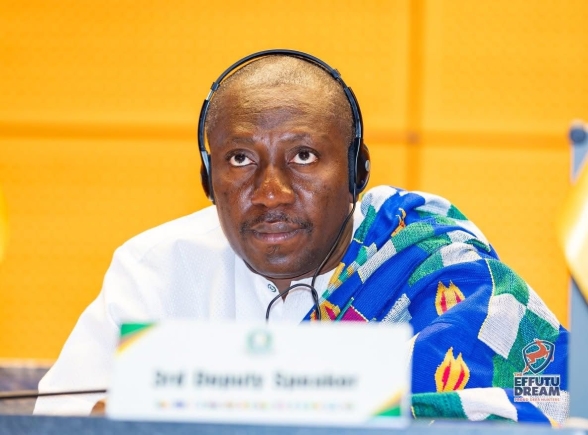
Mr Afenyo-Markin also turned attention to the insecurity in the Sahel, sharing the harrowing experiences of Ghanaian tomato traders in Titao in northern Burkina Faso, resulting in the death of eight Ghanaians and other West Africans in terrorist attacks as well as similar insurrection and terrorist activities in Mali, and as such calling on ECOWAS to act decisively to protect its citizens.
“These were not statistics.
They were breadwinners, fathers and sons — the quiet engines of a regional supply chain that feeds our markets,” he said, stressing that “their deaths exposed a dangerous structural truth: Ghana's food supply chain runs directly through one of the most lethal conflict zones on earth” – the Liptako-Gourma tri-border region, which he said, accounted for more than half of all terrorism-related deaths worldwide in 2025.
The Minority Leader consequently called on the ECOWAS Parliament to demand accountability and press for an ECOWAS Civilian Protection Framework covering traders and workers in conflict zones.
“A regional community that cannot protect its own citizens in transit has not yet earned its name,” he said.
ECOWAS free movement
In the judgement of the Minority Leader and Third Deputy Speaker of the ECOWAS Parliament, ECOWAS had not fully kept faith with the 1979 Protocol on the Free Movement of Persons, and that nearly half a century after it was signed, that promise remained deeply incomplete.
Mr Afenyo-Markin indicated that while formally the architecture existed in the 90-day visa-free movement, and the ECOWAS Travel Certificate, among others, the daily reality of citizens contradicted it at every turn.
