
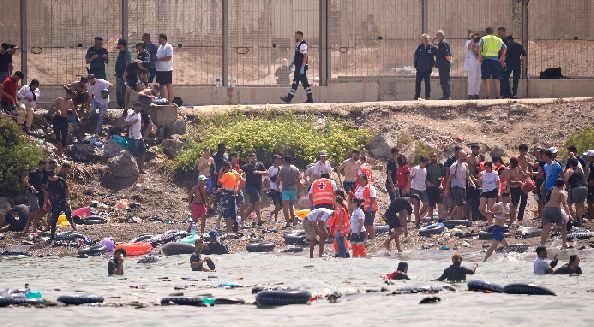
At least nine people have died after thousands of migrants crossed from Morocco into the Spanish North African enclave of Ceuta, prompting Spain to deploy military personnel and additional security forces to contain one of the largest border surges in recent years.
Spanish authorities estimated that between 2,000 and 3,000 migrants entered Ceuta on Thursday, with many swimming around border barriers at Tarajal beach or forcing their way through sections of the frontier.
The sudden influx overwhelmed local reception facilities and security services, leading the central government to reinforce the enclave with troops and additional police officers.
Officials said the bodies of nine migrants were recovered during the crossings, adding to growing concerns over the humanitarian risks associated with irregular migration along one of Europe's busiest entry routes.
Spanish Prime Minister Pedro Sánchez and Interior Minister Fernando Grande-Marlaska were expected to visit Ceuta as authorities sought to restore order and assess the situation.
Local authorities called for a national emergency declaration, arguing that the enclave's limited resources had been stretched beyond capacity, although the central government declined the request.
The migration surge comes weeks after Spain's Supreme Court ruled that migrants intercepted after entering Ceuta by sea cannot be immediately returned to Morocco without legal proceedings.
Spanish officials have suggested that criminal smuggling networks may have exploited the ruling by encouraging migrants to make the dangerous crossing.
Moroccan security forces responded by deploying riot police along parts of the border, using tear gas and water cannons in attempts to prevent further crossings.
Rabat has reiterated its commitment to cooperating with Spain in managing migration and combating human trafficking networks.
Ceuta, together with the nearby Spanish enclave of Melilla, forms the European Union's only land border with Africa and has long been a focal point for migrants seeking entry into Europe.
The territory has experienced several migration crises in recent years, including a major influx in 2021 that strained diplomatic relations between Spain and Morocco.
The latest incident has reignited debate across Spain over border security, migration policy and the European Union's management of irregular migration, with opposition parties calling for tougher border controls while the government insists that international cooperation remains the most effective response to the crisis.
