

Dear Mirror Doctor, why is hypertension such a common condition?
These days it is seen in younger people. Kindly explain why hypertension is on the rise now.
Young, Kumasi.
The whole world has seen an improvement in infectious diseases so the non-communicable diseases will now be the main focus.
I suspect that hypertension has always been with us just that it was overshadowed by malaria and other infectious diseases.
Worldwide, though, hypertension is so prevalent that a day has been set aside to observe it.
The main duty of the heart is to collect blood and pump blood from the heart to every organ in the body. The blood carries oxygen from the lungs to the rest of the body in order for the body to function efficiently.
The heart pumps blood into the arteries (the vessels that carry blood away from the heart to the various organs) with enough force to push blood to the far reaches of each organ from the top of the head to the bottom of the feet.
Blood pressure can be defined as the pressure of blood on the walls of the arteries as it circulates through the body. Blood pressure is highest as its leaves the heart through the aorta- the largest vessel that takes blood away from the heart - and gradually decreases as it enters smaller and smaller blood vessels (arteries, arterioles and capillaries).
After supplying the rest of the body with the needed oxygen and nutrients, the blood returns to the heart to be pumped into the lungs to load up more oxygen.
The blood returns from the lungs and rest of the body to the heart through the veins, aided by gravity and muscle contraction.
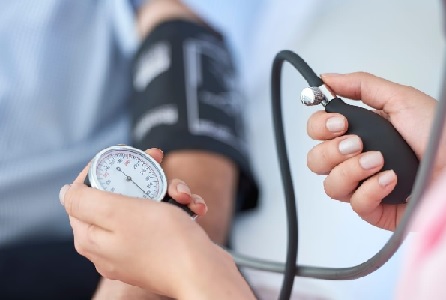
Hypertension is the medical term for high blood pressure. Blood pressure is measured with a blood pressure cuff and recorded as two numbers, for example, 120/80 mm Hg (millimeters of mercury). Blood pressure measurements are usually taken at the upper arm usually the right for standardisation.
The top, larger number is called the systolic pressure which measures the pressure generated when the heart contracts (pumps). It reflects the pressure of the blood against arterial walls.
The bottom, smaller number is called the diastolic pressure which reflects the pressure in the arteries, while the heart is filling and resting between heartbeats.
Many people have high blood pressure and yet they are unaware. Increasingly though, there is heightened public awareness of this condition.
It has moved from the erroneous impression of it being a "Whiteman’s disease" to it becoming one of the commonest reasons for medical consultation in this country.
The American Heart Association has recommended guidelines to define normal and high blood pressure in adults.
Normal blood pressure less than 120/80
Pre-hypertension 120-139/ 80-89
High blood pressure (stage 1) 140-159/90-99
High blood pressure (stage 2) higher than 160/100
In children, centile charts are used to determine limits of high blood pressure based on age. If the blood pressure plot is above the 95th centile for systolic or diastolic pressure for age, it is hypertension in children.
Uncontrolled high blood pressure may be the underlying reason for many cases of death and disability from heart attack, stroke and kidney failure.
According to research, the risk of dying from a heart attack is directly linked to high blood pressure, particularly systolic hypertension.
The higher the blood pressure, the higher the risk. Maintaining a lifelong control of hypertension decreases the future risk of complications such as heart attack and stroke.
In 90 per cent of people with hypertension, the cause is not known and is referred to as primary or essential hypertension.
Even though the specific cause is unknown, there are risk factors that can contribute to developing high blood pressure.
These factors are grouped as modifiable (can be changed) or not modifiable (cannot be changed).
Non-modifiable factors include:
Age: The older a person is, the greater the likelihood that he or she will develop high blood pressure, especially elevated systolic readings.
This is largely due to "hardening of the arteries."- a condition known medically as arteriosclerosis as one ages.
Race: African Americans develop high blood pressure more often than their Caucasian counterparts.
Also, Black people develop high blood pressure at younger ages and it only stands to reason that they will develop more severe complications sooner in life comparatively if not controlled.
Socioeconomic status: High blood pressure is found more commonly among the less educated and lower socioeconomic groups.
For example, it is known that residents of the southeastern United States, irrespective of race, are more likely to have high blood pressure than residents of other regions.
Family history (hereditary): The tendency to have high blood pressure appears to run in families.
Thus, if one or both parents have hypertension, the tendency to develop hypertension is higher than somebody with no family history of hypertension.
Gender: Generally, men have a greater likelihood of developing high blood pressure than women. This likelihood varies according to age and among various ethnic groups.
Obesity: As body weight increases, the blood pressure rises. Being overweight increases the risk of high blood pressure.
Obese people are two to six times more likely to develop high blood pressure than those with weight within a healthy range.
Besides the degree of obesity, the way the body accumulates extra fat is also relevant. Some people gain weight around their belly (central obesity or "apple-shaped" people), while others store fat around their hips and thighs ("pear-shaped" people).
"Apple-shaped" people tend to have greater health risks for high blood pressure than "pear-shaped" people.
I will continue next week
The Mirror Doctor is a member of the Paediatric Society of Ghana and the Director of Medical Affairs, the Korle Bu Teaching Hospital.
