
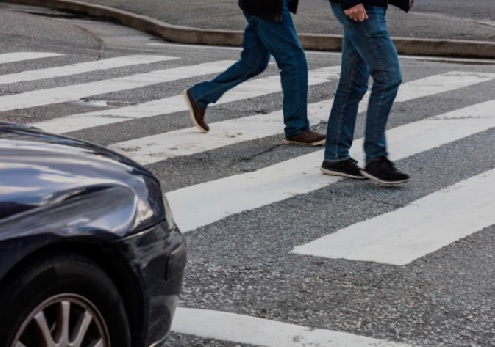
Designed to provide pedestrians with a safe passage across roads, zebra crossings are intended to be areas where drivers stop and allow people to cross.
However, the reality on many roads in Accra tells a different story.
Motorists frequently ignore these crossings, forcing pedestrians to wait for long periods or take dangerous risks by crossing between moving vehicles.
A visit to several busy roads in Accra reveals a worrying pattern. Drivers often speed past zebra crossings without slowing down, even when pedestrians are visibly waiting. In some cases, motorists accelerate as people approach the crossing, effectively denying them the right of way guaranteed under road traffic regulations.
The consequences of this behaviour extend far beyond inconvenience. According to the National Road Safety Authority (NRSA), 2,930 pedestrians were knocked down in Ghana in 2021, resulting in 831 deaths.
Research further indicates that more than 70 per cent of pedestrian fatalities occurred during road crossings, while speeding was a contributing factor in approximately 65 per cent of pedestrian deaths.
Troubling
These figures paint a troubling picture of road safety in the country. The situation remains alarming. Between January and August 2025, the NRSA recorded 9,626 road crashes and 1,937 deaths nationwide. During the same period, pedestrian knockdowns increased by 8.1 per cent compared with the corresponding period in 2024.
These statistics indicate that despite years of road safety campaigns, pedestrians continue to face significant dangers on Ghana's roads.
For residents of Accra, the threat is particularly severe. Reports indicate that pedestrians accounted for 56 per cent of road traffic fatalities in the Accra Metropolis in 2024.
This means that more than half of those who lost their lives in road crashes were people on foot rather than occupants of vehicles.
Experts
Road safety experts attribute the disregard for zebra crossings to a combination of factors. One of the most significant is driver impatience.
Faced with heavy traffic congestion, many motorists prioritise reaching their destinations quickly and view stopping for pedestrians as an unnecessary delay.
Weak enforcement of traffic regulations also contributes to the problem.
Drivers who fail to stop at zebra crossings are rarely sanctioned, creating the perception that such violations carry little or no consequence.
Without consistent enforcement, compliance becomes largely dependent on individual discipline.
Another challenge is inadequate road infrastructure. In some areas, zebra crossing markings have faded and become difficult to identify.
Poor signage and insufficient street lighting further reduce the visibility of crossing points, especially at night.
Although motorists bear the primary responsibility for pedestrian safety, some pedestrians also contribute to the problem by crossing roads at undesignated points instead of using available crossings.
However, road safety advocates argue that this should not excuse drivers from obeying the law and protecting vulnerable road users.
The disregard for zebra crossings reflects a broader issue of road indiscipline that continues to claim lives across the country.
What should serve as a symbol of safety has, in many instances, become a place of fear and uncertainty.
Stakeholders believe the solution lies in a combination of stricter law enforcement, public education, improved road infrastructure, and a renewed commitment to respecting the rights of all road users.
Traffic officers must enforce existing regulations, while drivers must recognise that yielding to pedestrians is not an act of courtesy but a legal and moral obligation.
The tragedy of the zebra crossing is not simply about road markings being ignored.
It is about lives being endangered, rights being denied, and a safety measure failing to fulfil its purpose.
The question is no longer whether the problem exists, but whether enough is being done to address it before more lives are lost.
Student of UniMAC -IJ.
E-mail:
Student Journalist.
