

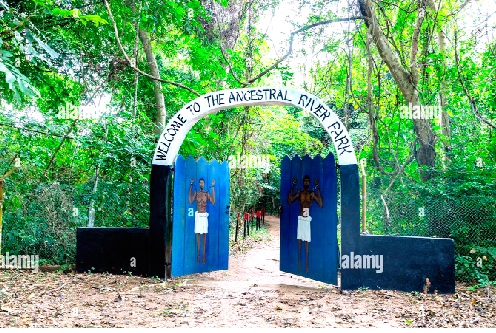
Deep in Ghana's Central Region is a site that once formed an important link in the machinery of the transatlantic slave trade.
Today, visitors come here not simply to see a historical monument but to confront a painful chapter in African history.
Ghana has more than 30 documented sites associated with the slave trade, including the Salaga slave market and wells in the north, Assin Manso in the south, and the coastal castles of Elmina and Cape Coast.
Among these, Salaga and Assin Manso were significant inland markets through which captives were processed before being transported towards the coast.
Captives brought from territories north of present-day Ghana, including areas of today's Burkina Faso, Côte d'Ivoire and Niger, were marched southwards in chains and shackles.
The journey could cover hundreds of miles, through forests and difficult terrain, under conditions of hunger, exhaustion, exposure and violence.
By the time they arrived at Assin Manso, many were physically weakened.
Here, they were sorted according to age and sex. But Assin Manso was more than a market. It was also a place of preparation for the final stage of a journey that would take many captives to the coastal forts and eventually across the Atlantic.
The most poignant feature of the site is the Slave River, locally referred to as Donkonsu. Here, captives were brought for what has become known as their last bath. The phrase is chilling because the bath was not an act of comfort or dignity. It was part of the process of preparing human beings for sale.
Captives were taken to the river in batches, still in chains and shackles. They were made to bathe while their captors kept watch.
According to the historical account presented at the site, the calmer waters of the Slave River were preferred to the nearby main river, particularly during the rainy season, when stronger currents might have offered an opportunity for escape.
After the bath came inspection
Captives were subjected to physical examinations intended to establish their age and strength. Their teeth could be inspected.
They were made to perform vigorous exercises. Palm oil or shea butter was rubbed onto their bodies, partly to treat wounds and bruises but also to make them appear more presentable for sale. From Assin Manso, those who survived were marched onward to the coastal castles.
One intriguing feature of the landscape is the presence of pineapple plants. Historical accounts at Assin Manso associate the plants along the old route with the movement of captives from Salaga to the south, suggesting that they served as natural landmarks for those transporting captives through unfamiliar territory.
Assin Manso also raises a broader question about how Africans preserve history. At a small cultural-history display near the site, visitors are introduced to the tradition of the blackened stool, an important form of historical remembrance among Akan communities.
When a chief dies, his stool may be blackened and preserved as a symbol of his reign. The practice allows the community to retain the memory of particular chiefs and their public lives.
This is especially significant when considering Africa's encounter with the transatlantic slave trade. Much of its history survives through a combination of written records, oral testimony, archaeological evidence, monuments and community memory.
Assin Manso became even more prominent in Ghana's modern remembrance of slavery with the inauguration of the Emancipation Festival in 1998.
That year, the remains of two people of African descent, Madam Crystal and Samuel Carson, were symbolically brought back to Ghana. Their return was incorporated into a ceremony intended to challenge the historical symbolism of the coastal “Door of No Return”.
The remains were taken from Accra through the Atlantic route to Cape Coast and then to Assin Manso, where a funeral ceremony was held on July 31, 1998. The following day marked the beginning of the Emancipation Festival.
The symbolism was powerful: those once taken away could, in death and memory, return to the African homeland. Today, a Memorial Wall of Return at Assin Manso invites members of the African diaspora to inscribe their names as an expression of reconnection with ancestral Africa.
That is, perhaps, the deeper significance of this place. The river that once witnessed the forced preparation of captives now receives visitors seeking understanding.
The path that once led people towards enslavement has become a heritage trail. And the “last bath” has become a memorial to those who never had the opportunity to choose where their journey would end.
In travelling to places such as Assin Manso, we are reminded that tourism is not always about escape from history. Sometimes, Going Places means going back into history and having the courage to remember.
