
2026 Budget: EduWatch boss praises education allocation but calls for reforms on Double Track, GETFund and STEM fees
The Executive Director of Africa Education Watch, Kofi Asare has described the GH¢49 billion allocated to education in the 2026 budget as commendable, representing a 16 per cent increase over the 2025 figure and 16.2 per cent of the total national budget, thereby meeting one key international benchmark.
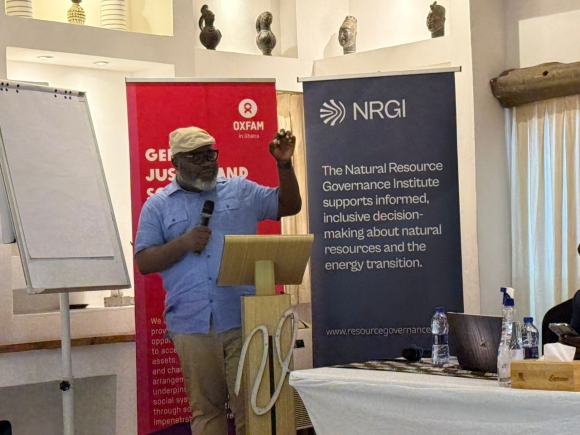
Speaking on the sidelines of the Civil Society Organisations Budget Forum held on Wednesday in Accra, Mr Asare, however, stressed that the allocation still falls short of the crucial four per cent of GDP benchmark and urged the government to aim for at least 20 per cent of the national budget, given the high cost of Ghana’s secondary education system.
“That is commendable. Again, it represents 16.2% of the total national envelope. And so it meets minimum international benchmark, but falls short of GDP equivalent of 4% which is another important indicator of education financing,” he said.
Despite the tight fiscal space, Mr Asare acknowledged a clear commitment by the government to fund education, but insisted the real test would be in equitable distribution across sub-sectors and efficiency in spending.
He welcomed the GH¢1.3 billion allocated for school furniture in 2026, noting the acute deficit of over one million desks in basic schools, but called for a radical shift in procurement practices.
“I want to see a different approach in furniture procurement to give a true meaning to budget execution, budget credibility and efficiency,” he stated.
Mr Asare demanded that all contracts for school furniture include long-term warranties of at least three to five years, an international best practice already adopted in several African countries.
“You talk to the schools, you realise that some desks barely last a year, then they break down. So we need warranties in all desk contracts so that we can assure the citizens of value for money,” he added.
The EduWatch boss also praised significant investments in basic education infrastructure, including the planned construction of 461 new schools financed through GETFund and other sources, with GH¢2 billion from the District Assemblies Common Fund and the Gulf of Guinea Northern Regions Social Cohesion project.
On secondary education, Mr Asare expressed strong support for government’s announced plan to end the double-track system within two years, but described the GH¢1.1 billion allocated for upgrading 80 senior high schools and completing E-blocks as inadequate.
“We want to see much more. Want to see a lot more urgency attached to this, and perhaps supplementary funding provided in the mid-year budget so that we can complete all these projects and end double track within the two-year framework,” he urged.
Mr Asare raised serious concerns about the GH¢4.2 billion allocated to the Free Senior High School policy, pointing out that it now consumes virtually half of GETFund resources, with roughly 70 per cent of that amount going to feeding alone.
“Free Senior High School is virtually taking about half of GETFund. GETFund originally meant for infrastructure, Free Senior High School is mainly feeding... So if you have about half of it going to Free Senior High School, then there’s a problem because by the time we take care of all the other free items that are all being funded from GETFund, there’s very little left to expand secondary education infrastructure,” he warned.
With the previous sources of capital financing such as the Annual Budget Funding Amount redirected to the Big Push infrastructure programme, Mr Asare said GETFund has become the only reliable source for school infrastructure, leaving tertiary education particularly vulnerable.
He therefore called on the government to prioritise innovative financing mechanisms, including public-private partnerships and corporate social responsibility initiatives, to expand dormitories, lecture halls and faculties at the tertiary level.
Finally, Mr Asare criticised the no-fee-stress policy for failing to cover the full academic user fees of STEM students, who often pay significantly higher amounts than their humanities counterparts.
He pointed out that while the policy may cover nearly 100 per cent of fees for humanities programmes costing GH¢3,000–4,000, STEM students, especially in medicine, pharmacy and engineering at universities such as UDS, UCC or KNUST, can pay up to GH¢10,000, with government covering only 50–60 per cent in many cases.
“If we are minded that people we need most in this country are STEM products and not humanities products, then we should be able to increase the STEM one to cover 100% of their AUF so that we know that no one given an admission to go and read medicine will be deprived of an opportunity to go because money because no-fee-stress only covered a portion of their fees,” he declared.
Mr Asare advised the government to fully fund all STEM programmes despite fiscal constraints, arguing that Ghana cannot afford financial barriers that prevent the training of the doctors, engineers and scientists the economy desperately needs.
