
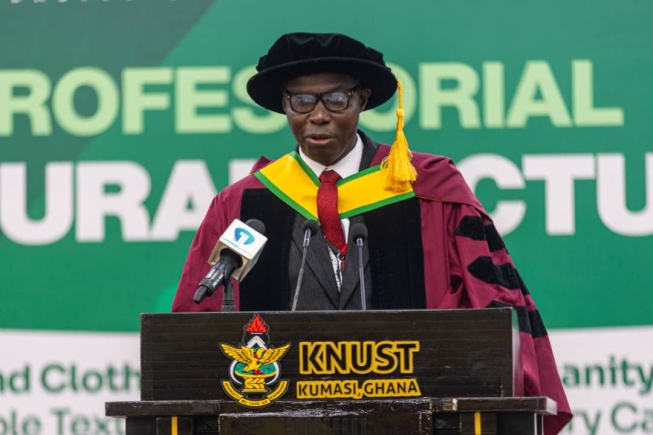
The Vice-Dean of the Faculty of Art at the Kwame Nkrumah University of Science and Technology (KNUST), Professor Ebenezer Kofi Howard, has underscored the need for Ghana to develop a sustainable raw material base for textile and apparel production to revive the industry and reduce dependence on imports.
"The sustenance of textiles and apparel production depends largely on the availability and quality of raw materials," he said.
He explained that it was, therefore, economically prudent for Ghana to develop a sustainable raw material base for both natural and synthetic fibres to support the growth and development of the textile and apparel sector.
Inaugural lecture
Professor Howard made the remarks while delivering his inaugural professorial lecture at the Great Hall of KNUST.
The lecture was on the theme: "Beyond Clothing the Nudity of Humanity: How a Sustainable Textiles and Apparel Industry Can Rescue Ghana from Its Socio-Economic and Environmental Quagmire."
He cited a 2022 Ghana Statistical Service report, which indicated that Ghana imports more than 70 per cent of its textiles and garments, primarily from China and other Asian countries, while exporting less than 10 per cent.
As a result, he said, the country's textile industry had experienced a significant decline, with an annual output capacity of fewer than 10 million yards and fewer than 2,000 employees across the four surviving large-scale textile firms.
Professor Howard further called for the restructuring of the National Cotton Development Authority (NCDA), with a clear mandate to regulate, coordinate and promote the cotton sector to ensure sustained growth.
"We must leverage our petrochemical resources for the production of commercially viable synthetic fibres. Establishment of an 'Industrial Dyes Park' for the manufacture of textile dyes and auxiliaries will be a game-changer to reduce the over-reliance on expensive imported dyes and auxiliaries," he added.
Drive 24-Hour Economy Policy
Professor Howard recommended the garment sector as a practical driver of the government's 24-Hour Economy Policy.
"I am optimistic that the implementation of a policy framework proposed to establish textile and apparel firms in all 16 regions will be a game-changer," he said.
He explained that the proposal was based on the industry's proven success in major economies and Ghana's own experience during the 1960s, when textile manufacturing supported shift systems that employed multiple cohorts of workers, boosted productivity and generated employment.
Policy
Professor Howard said Ghana's garment industry had operated for years without a clear policy direction but noted that, in 2025, the government developed a Textiles and Garment Manufacturing Policy, which is currently under review for implementation.
However, he said an expert review of the policy document revealed an over-reliance on cotton and expatriate expertise. He, therefore, advocated a revision of the policy to promote broader raw material exploration and ensure greater involvement of Ghanaian experts and institutions.
"For the policy to enhance the economic outlook of Ghana with impactful gains, its implementation to be done without a political lens, but strictly based on the principles of meritocracy, pragmatism and honesty," he indicated.
Learn from successful countries
Professor Howard said Ghana could also draw valuable lessons from countries that had successfully used the textile and apparel sector as a catalyst for industrial growth and job creation.
"If countries such as Cambodia, Vietnam, Bangladesh and Sri Lanka have successfully capitalised on the garment sector to transform their economies and create jobs to improve the livelihood of their citizens, then I am optimistic that Ghana can do better with good leadership and favourable policies," he said.
Commendation
The Vice-Chancellor of KNUST, Professor Mrs Rita Akosua Dickson, who chaired the lecture, commended Professor Howard for his contributions to the growth of Ghana's textile and apparel sector.
She further urged the government, academia and industry to strengthen collaboration to enable the country to harness the full potential of the textile and apparel industry to drive economic growth and create sustainable employment.
