


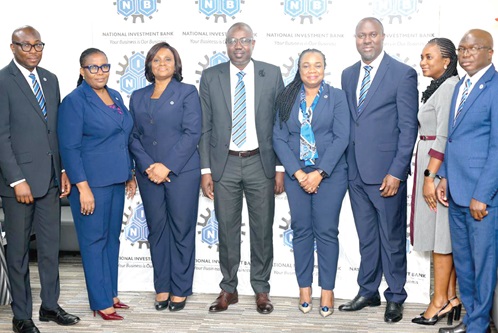
The National Investment Bank (NIB) has rallied itself out of the financial challenges, posting GH¢343.9 million profit after tax for last year, with a renewed momentum to sustain and improve on the performance going forward.
“As at the close of the 2025 financial year, the figures have turned around, a sustained turnaround’’, the Managing Director of NIB, Chief Doli-Wura Zakaria, told a section of the financial press last Tuesday.
“We closed the year with a profit after tax of GH₵343.9 million. Total equity at the close of the year stood at GH₵1.55 billion, operating income was over 135 per cent increase, net interest income was 212 per cent increase and growth for the year was 58 per cent,” he added.
Mr Zakaria said the profitability and the financial turnaround and growth trajectory was sustained into the first quarter of this year across the board, stressing “the story is not going to change but remain the same for the second, third and fourth quarters.”
The bank also returned a positive total equity of GH₵1.55 billion for the year under review, supported by the GH₵3.43 billion in committed capital from the government, which owns 93 per cent of the bank.
Background
Touching on where the bank had come from, Mr Zakaria added “The capital adequacy was negative 46.96 per cent. Profit as at that particular period was GH₵2.7 million, with retained deficit being more than GH₵2 billion. This was not just rough years of a bank, but it was totally collapsing slowly”.
However, as of the end of last year, the bank had also increased its total assets to GH₵12.22 billion, from GH₵5.84 million in 2024 and GH₵2.95 billion in 2022; customer deposits surged from GH₵6.47 billion in 2024 to GH₵10.20 billion in 2025, while loans and advances increased from GH₵670 million to GH₵730 million within the same period.
NIB’s interest income also increased from GH₵720 million in 2024 to GH₵1.23 billion last year, while non-interest income also rallied from the 2024 figure of GH₵170 million to GH₵250 million in 2025, leading to the GH₵343.9 million profit, up multiple fold from the GH₵3 million profit posted for 2024.
Indeed, for 2022 and 2023, NIB posted significant losses of GH₵613 million and GH₵57 million respectively.
Context
The Domestic Debt Exchange Programme (DDEP) coupled with a significant default of the bank’s construction loan portfolio, NIB took a deep hit with large impairments and provisions for non-performing loans, leading the bank into insolvency in 2022.
Haing supported the construction sector with about 42 per cent of its loan book, the inability of the government to pay many contractors, despite having interim payment certificates, rendered most of the loans non-performing.
The Bank of Ghana restricted the bank’s ability to provide credit, until last year when they were allowed to do so again.
Throwing more light on the numbers, the Chief Finance Officer of the bank, Mohamed Gausu, said sustained balance sheet expansion and revenue diversification underpinned the bank’s turnaround and return to profitability in 2025.
He said many of the bank’s corporate customers and large depositors renewed their faith in the bank given the turnaround, thus shoring up its deposits significantly.
Mr Gausu said the BoG had also lifted the restrictions on the bank not to lend and that had allowed the bank to move into new areas to offer more loans to match the enlarged deposit position of NIB.
“For instance we have room to take on large single obligor transactions,” he said, adding that during the first quarter of this year the bank had done about half a billion in loans in low risk areas.
The CFO also explained that NIB had adopted multiple measures to reduce its NPLs, which stood at 69.7 per cent in 2025, down from 76 per cent in 2024, including an aggressive recovery strategy and negotiated settlements.
Outlook
In a presentation that chronicled the establishment and general history of the bank, the Chief Treasury Officer, Osman Soale Atchulo, said the bank had rolled out a three-year growth strategy anchored on five pillars.
The pillars include strict adherence to regulatory capital adequacy requirements and aggressive mobilisation of low-cost deposits; digital transformation to bring about end-to-end automation of operations; operational efficiency, and achieving human capital and service excellence through staff motivation, among others.
Mr Atchulo said this year’s priority areas would cover rolling out its core banking platform, redesigning key credit and operational workflows to eliminate redundancies before automation, as well as cost rationalisation through the implementation of strict procurement controls and vendor contract renegotiations to curb operational expenditure and spur growth.