
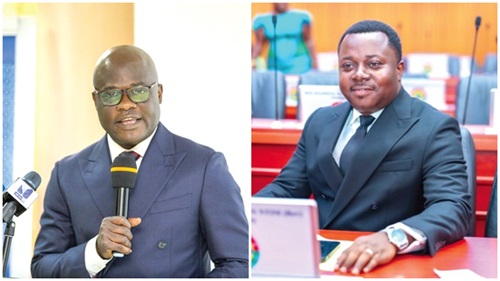
2026 Budget debate: Majority calls it best in 17 years - It’s empty – Minority
The Majority in Parliament has defended the 2026 Budget Statement and Economic Policy, citing the GH¢1.4 billion allocation to local governance, restored macroeconomic stability and the 103 per cent increase in capital investment as the building blocks that will strengthen the economy.
The Majority also mentioned investments in roads, water supply, technical universities and education in general, thermal power and digitalisation of lands as far-reaching interventions that reflect long-term development and good governance.
The Minority, however, raised concerns over the 2026 Budget, accusing the government of misallocating resources to luxury jets, while security services, power and rail infrastructure remain underfunded.
The Minority caucus described the budget as empty, citing delayed releases of goods and services and unfulfilled digital initiatives.
The two sides made the arguments in the ongoing debate over the budget yesterday in a chamber presided over by the First Deputy Speaker and Member of Parliament for Akatsi South, Bernard Ahiafor.
Majority
The MP for Banda, Ahmed Ibrahim, declared the 2026 Budget “the best in my 17-year stay in this House,” arguing that the NDC had restored macroeconomic stability.
Defending the execution of the 2025 budget as an anchor for 2026, he buttressed his point with the ECOWAS convergence criteria which indicated that the third quarter of 2025, the country had met five out of six.
Mr Ibrahim, who is also the Minister of Local Government, Chieftaincy and Rural Development, therefore, celebrated the nation’s current credit rating upgrades and contrasted it with the New Patriotic Party’s (NPP)’s performance, saying; “You took us to a junk economy.”
He added at local governance level, the government had disbursed GH¢1.4 billion in the first quarter alone, equalling the NPP’s four-year total.
The MP for Asunafo South and Minister of Food and Agriculture, Eric Opoku, defended the capital expenditure, saying capital investment induced long-term economic development and poverty reduction, accusing the opposition MPs of ignoring substance, while criticising progress.
Mr Ibrahim further argued that the National Democratic Congress (NDC) had achieved a “103 per cent increase” in capital investment, raising it from GH¢38 billion to GH¢77 billion,” urging the Minority to have a better appreciation of the budget’s structure.
He also pointed to full funding for the Ghana Education Trust Fund (GETFund), health insurance scheme, road maintenance and education infrastructure, including two technical universities and plans for more.
Mr Opoku also emphasised investments in the Accra-Kumasi expressways and thermal power plant to generate 1,200 megawatts.
Minority
When he caught the eye of the Speaker, the MP for Assin South, John Ntim Fordjour, criticised the 2026 budget for misaligning security priorities, highlighting rising insecurity, internal displacement and galamsey as a national threats.
The MP, who is also the Ranking Member of Defence and Interior, condemned the allocation of GH¢3.6 billion for luxury jets and helicopters for the President, while essential security needs — fighter jets, Unmanned Aerial Vehicle (UAVs) and proper equipment for the police, fire and immigration services — remained underfunded.
He accused the NDC of hypocrisy, emphasising their previous opposition to military retooling, and stressed that budgetary resources should focus on operational readiness and protection of citizens rather than executive luxury.
“Where is the one billion you promised the security services?
The situation is so sad when you visit our airports and seaports. Only one has a narcotics scanner,” he lamented.
The MP for Manhyia North, Akwasi Konadu, argued that the 2026 Budget had no integrity and that the government was reaping the NPP gains.
He enumerated failed or undersubscribed programmes and warned against renaming projects without delivering results.
He also called out restrictions on local contractors and poor decentralisation, which stifled industrialisation at the community level.
Mr Konadu argued that the budget failed to meet its stated goals of job creation and economic transformation, and rather erased prior gains and undermined citizen’s confidence.
The MP for Mpraeso, Davis Ansah Opoku, argued that the budget was empty, and accused the government of failing to release funds.
“Mr Speaker, at the end of the day, in the 2026 budget, we all got to find out in this house that only 56 per cent of goods and services was released.
It is not surprising that you walk through some ministries and their lifts are not working, common pen, A4 sheets are not there for people to work with,” he said.
On capital expenditure, he lamented that only 34 per cent had been released and questioned how the Big Push would be financed.
The MP for Gushegu , Alhassan Tampuli Sulemana, criticised the government’s power and transport policies, warning against signing additional power purchase agreements despite 5,300 megawatts (MW) installed capacity and peak demand of 3,500MW, which he said would create financial burden on Ghanaians.
He also pointed out insufficient funding for railways, citing a mere GH₵70 million allocation against the billions needed for strategic lines to support mining and trade.
Majority
The MP for Bole Bamboi, Yusif Sulemana, accused the NPP under President Nana Addo Dankwa Akufo-Addo of abandoning roads and hospitals, citing projects in his constituency as examples.
He, therefore, lauded President John Dramani Mahama for providing potable water, using Kyebi, the former President’s hometown, to support his point.
On policy, he defended the digitalisation of lands, emphasising that retaining internally generated funds (IGF) would fund reforms.
“President Mahama and the Minister are providing a solution.
There is no money.
It is estimated that we will need about $160 million to fix the problem.
They will allow the Lands Commission to retain its IGF 100 per cent and that can be a source of payment to any individual or any company that wants to partner with the Lands Commission to be able to resolve this problem.
This is what we call governance,” he explained.
The MP for Builsa North, James Agalga, countered claims of rising insecurity, arguing that NPP-era failures worsened the Bawku conflict.
He said NDC never opposed retooling, insisting that the party supported fighter jets and blamed the previous government’s debt crisis for the collapsed procurement.
“Mr Speaker, that deal did not go through because of the reckless management of this economy by President Akufo-Addo and his cousin, Ken Ofori-Atta, who led this country into a debt restructuring scenario.
And because we're undergoing debt restructuring, the facility we took from the Czech Republic just didn't work and so the jets never came.
Whose fault is it that the jets never came,” Mr Agalga asked.
He defended aircraft purchases, clarifying that they were for troop transport, adding that President Mahama had been flying commercially and would never “rent private jets.”
