
AGI advocates full-scale industrialisation to curb raw material dependency
Ghana must take advantage of the global economic shift as a rare opportunity to pursue a full-scale industrialisation agenda anchored on manufacturing-led growth, the Association of Ghana Industries (AGI) has proposed.
The association explained that decades of missed opportunities had left the country overly dependent on raw material exports, particularly under a globalisation model that positioned Africa and Ghana mainly as a supplier of raw materials and a market for finished goods.
It stated that the present moment demanded bold and deliberate policy choices such as the development of a well-structured manufacturing policy with clear implementation programmes, strong cross-sector linkages and a value-chain approach to drive industrial growth and job creation.
“This is a once-in-a-century opportunity to allow manufacturing to grow and thrive at the bedrock of this economy,” a former President of AGI, Dr Tony Oteng-Gyasi, said at the investiture dinner of the association in Accra last Wednesday.
Investiture
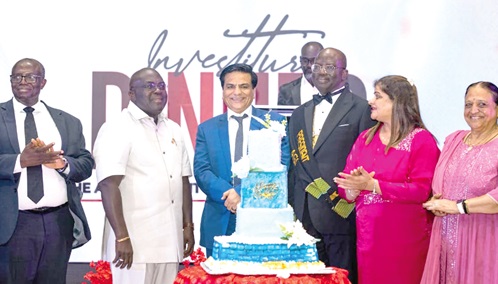
The investiture was used to swear in the new President of the AGI, Kofi Nsiah-Poku, the Founder and Managing Director of Kinapharma, and the national council members.
The new president, the Vice-President, Mukesh Thakwani and members of the national council are to steer the affairs of the association for the next two years.
It was attended by government officials, business executives and trade associations, including the Chief of Staff, Julius Debrah; President of the Ghana Union of Traders Association (GUTA), Clement Boateng; and President of the Ghana National Chamber of Commerce and Industry (GNCCI), Stephane Miezan.
Economic backbone
Dr Oteng-Gyasi, who was the chairperson for the occasion, said the country’s manufacturing sector had the potential to drive inclusive growth by stimulating activity across banking, insurance, construction and distribution.
He explained that no economy in the world had achieved sustained development without a strong industrial base.
He stressed that placing manufacturing at the centre of economic planning would help generate sustainable jobs for the country’s growing youthful population and reduce vulnerability to external shocks.
Private sector leadership
Dr Oteng-Gyasi called for closer collaboration between the government and the private sector to ensure that industrial policies were practical, well coordinated and effectively implemented.
He said the establishment of a presidential advisory group on the economy, made up of experienced private sector leaders, presented an opportunity to align policy decisions with the realities of manufacturing and industry.
“This is the time for deliberate coordination between policymakers and industry players to ensure that manufacturing truly becomes the bedrock of our economy,” he added.
The new president said his election represented a clear mandate to serve and reposition the association as a stronger force in national development.
He said that the responsibility placed on the new leadership went beyond ceremonial duties; it came with high expectations from members to deliver tangible results.
He explained that the association would prioritise collaboration with national programmes such as the 24-hour Economy to expand production, boost exports and create sustainable jobs.
“Together, we must strengthen AGI’s influence, deepen its capacity, sharpen its advocacy, and enhance its contribution to the industrialisation agenda of Ghana,” he stated.
Central role
The Chief of Staff at the Presidency said the central role of the private sector in driving industrial transformation, sustainable job creation and economic resilience could only be realised through strong collaboration between government and business..
Mr Debrah stressed that Ghana stood at a critical juncture where long-standing calls for diversification and value addition had to translate into concrete outcomes, rather than rhetoric.
He argued that this would require an innovative, export-oriented private sector, supported by a predictable and accountable public sector.
“Policies alone will not transform our economy; what will make the difference is execution, and here AGI has a critical role to play,” he added.
