
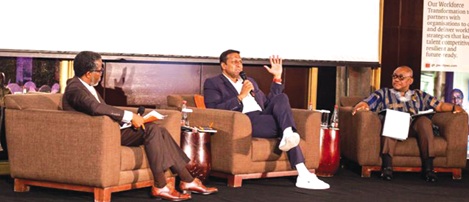
AI must be treated as workforce transformation, not tech project — CEO, Fair Wages and Salaries Commission
The Chief Executive Officer (CEO) of the Fair Wages and Salaries Commission, Dr George Smith-Graham, has advised organisations to treat artificial intelligence (AI) as a workforce transformation agenda rather than merely a technology initiative.
He explained that many chief executives across Africa believed AI would significantly reshape business operations. However, he cautioned that investment in technology alone would not automatically deliver productivity gains.
“Just because you invest in AI does not mean it is adding to efficiency and performance,” he said, stressing that the real impact of AI depends on how well employees are equipped to use it.
Dr Smith-Graham made the call during a panel discussion at the PwC Africa Hopes and Fears Survey Forum in Accra on Wednesday.
The forum brought together industry players, academia and policy makers to explore how Africa can connect the future of work in ways that deliver sustainable performance and build lasting trust at a time when AI and rapid technological acceleration are combining workplaces across Africa.
He emphasised that organisations must go beyond deploying digital tools and instead rethink their entire value chains, including human resource management, skills development and decision-making processes.
“If we approach AI as a standalone IT project, we will miss the bigger opportunity.
AI should free up people from transactional tasks and enable them to focus on higher-value thinking and strategic decision-making,” he stated.
According to the PwC Africa Workforce Hopes and Fears Survey, AI will transform 49 per cent of jobs in Africa within three years.
The survey also reveals that whilst AI introduces uncertainty, 64 per cent of African workers feel confident in their job security.
Enhancing productivity
Dr Smith-Graham explained that Ghana was adopting AI within the public service to boost productivity and ensure employees work more effectively.
He emphasised that salary increases should no longer be automatic but must be tied to measurable performance improvements supported by AI-driven efficiency, noting that compensation growth must now be tied to increased efficiency and output, supported by AI adoption.
“We have gotten to a stage where we are not going to just allow employees to come and just ask for salary increases.
But we need to make sure that the increases are linked to productivity,” he added.
Upskilling
The Workforce Transformation Africa Leader for PwC South Africa, Professor Dayalan Govender, said, “As business leaders, we have the responsibility to take out fear and help our people make sense of AI in their respective functions rather than in general.”
He said there was the luxury of using AI just for its fancy benefits.
Instead, it was needed to increase efficiency, productivity and performance from a business perspective.
For his part, the Associate Director for Workforce Transformation at PwC Ghana, David Tsey, urged businesses to invest in learning ecosystems and digital training platforms to safeguard productivity.
“Just because you invest in AI does not mean it is adding to efficiency and performance.
The human capability to use it effectively is what will make the difference,” he added.
