
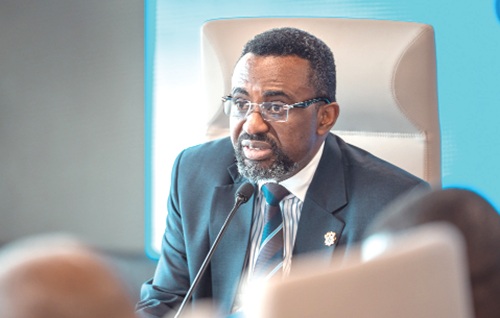
Escalating Middle East conflict risks higher inflation — Governor
The Governor of the Bank of Ghana (BoG), Dr Johnson Asiama, has cautioned that the escalating conflict in the Middle East can pose new risks to Ghana’s inflation outlook.
He explained that disruptions to key energy and shipping routes were increasing volatility in global oil markets, which could raise the cost of imported fuel.
Opening the 129th monetary policy committee (MPC) meeting in Accra yesterday, Dr Asiama stressed that sustained increases in oil prices could trigger imported inflation and tighten global financial conditions.
While geopolitical tensions may support higher gold prices and benefit Ghana’s trade balance, he said the overall impact could still heighten inflationary pressures.
The Governor said those external risks would be a key consideration in the bank’s monetary policy deliberations.
“This conflict is disrupting key energy and shipping corridors, it is increasing volatility in global oil markets, and it is introducing new uncertainty into the trajectory of global inflation”.
“For Ghana, the transmission channels are clear; the sustained oil price increases could raise the risk of imported inflation, and it could also tighten global financial conditions,” he said.
Background
Tensions in the Middle East escalated after joint military strikes by the United States (US) and Israel on Iranian targets in late February 2026, prompting retaliatory missile and drone attacks from Iran across the region.
The conflict has so far disrupted major energy infrastructure and shipping routes, particularly the Strait of Hormuz, a strategic waterway through which about one-fifth of the world’s oil supply normally passes.
The resulting disruption to tanker traffic, oil production and higher insurance charges on freight pushed global crude prices above $100 per barrel and raised concerns about rising fuel costs and inflation across many economies.
External risks, policy uncertainty
Despite the encouraging domestic performance, Dr Asiama cautioned that the global economic environment had become increasingly uncertain due to geopolitical tensions, particularly the escalation of conflict in the Middle East.
He explained that the disruption of major energy and shipping corridors had introduced fresh volatility into global oil markets and could affect the trajectory of global inflation.
“The external environment has changed since our last meeting. A significant external development has entered the picture, and that has to do with the escalation of the conflict in the Middle East,” Dr Asiama said.
The Governor said sustained increases in global oil prices could raise the risk of imported inflation for Ghana, while also tightening global financial conditions.
Although geopolitical tensions might support higher gold prices and provide some relief to Ghana’s trade balance, he stressed that the overall balance of risks could still be inflationary.
“For Ghana, the transmission channels are clear. Sustained oil price increases could raise the risk of imported inflation and also tighten global financial conditions,” the Governor said.
Dr Asiama added that the MPC would, therefore, need to carefully weigh these external risks as it deliberated on the appropriate monetary policy response.
Stronger economic outlook
Dr Asiama stated that the latest economic data since the committee’s last meeting in January indicated that the economy was stabilising faster than anticipated.
He said headline inflation had declined to 3.3 per cent in February, marking the 14th consecutive monthly drop and pushing inflation below the lower bound of the BoG’s medium-term target range.
The Governor said the development reflected significant progress in restoring macroeconomic stability after a period of high inflation and economic uncertainty.
“The data we now have suggests that the cautious stance we adopted earlier was well placed.
The improvement in the economy is in several important respects stronger than anticipated,” he said.
Dr Asiama stated that the real sector was also gaining momentum, with the bank’s Composite Index of Economic Activity expanding by 8.4 per cent year-on-year at the start of 2026, supported by improved business and consumer confidence and a gradual recovery in credit.
He said that fiscal performance had also improved, with the country recording a primary surplus of 2.6 per cent of gross domestic product (GDP) at the end of 2025, reversing a deficit of 3.9 per cent a year earlier.
The country’s gross international reserves also increased to $14.5 billion, equivalent to 5.8 months of import cover, Dr Asiama said.
“Taken together, these indicators point to an economy that is stabilising more quickly than many had expected,” he said, adding that such gains reflected the effectiveness of the ongoing economic reforms and policy discipline.
The seven-member committee, supported by advisors to the BoG and observers from the private sector and other stakeholders, will focus on the implications of inflation falling below the lower bound of the target range at this meeting.
Dr Asiama explained that while lower inflation was a positive development, the committee had to assess how the current policy stance interacted with the improving economic activity and the emerging global risks.
“At 3.3 per cent, inflation is not just within the target band; it is below the lower bound.
The committee must, therefore, assess what this means for an economy where activity is beginning to recover, and credit conditions are gradually improving,” he said.
External buffers
The Governor underlined the importance of strengthening the country’s external buffers through the Ghana Accelerated National Reserve Accumulation Programme (GANRA), which aims to increase international reserves to 15 months of import cover by 2028, up from the current 5.8 months.
Dr Asiama stressed the need to evaluate the role of the banking sector in supporting the transmission of monetary policy.
He explained that although banks remained sound, profitable and well capitalised, credit growth remained relatively subdued.
“In January, the committee was asked to exercise discipline in the face of improvement and resist the temptation to declare victory prematurely.
That discipline proved appropriate.
“But today, the judgment required is more complex.
We must make our decisions at the intersection of domestic success and growing external uncertainty,” the Governor added.
