
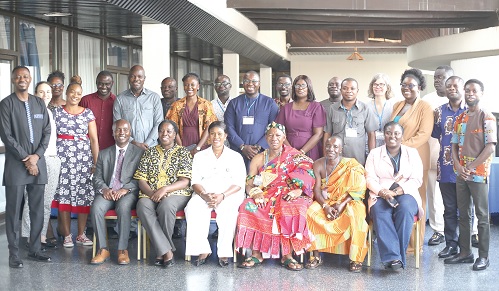
Ghana’s cocoa future threatened by galamsey - Experts warn
To protect Ghana’s cocoa future and maintain its global market position, the country must address illegal mining at the community level, not just through national policies, Global Director, Sustainable Cocoa and Coffee Programme, Abdulahi Aliyu Rikolto has said.
At the launch of a project in Accra yesterday to mobilise cocoa communities against illegal small-scale mining, he said efforts must go beyond enforcing regulations to empowering communities and providing viable livelihood alternatives, which he described as key to safeguarding both the environment and the long-term viability of Ghana’s cocoa sector.
The project is code-named ‘Mobilising Cocoa Communities Against Galamsey Destruction for Long-Term Livelihoods and Health’.
Mr Aliyu explained that the project would support cocoa communities in resisting illegal mining by creating alternative income opportunities for farmers, restoring degraded lands through agroforestry, and strengthening local advocacy to protect cocoa-producing landscapes.
Impact
Speaking about his interactions with farmers and local youth, Mr Aliyu recounted how a young man from Sikanti came to work on a cocoa farm, only to discover that the land had been converted to mining.
“He was left with two options: remain hungry or take up employment at a galamsey site.
The choice was clear for him.
This is happening in many cocoa communities,” he said.
Mr Aliyu added that farmers were aware of the negative impacts of galamsey, including polluted water bodies, increased cost of production and the risk of cocoa contamination.
“Community members know and feel the consequences, but without alternatives, survival often pushes young people into illegal mining,” he said.
Call to action
Mr Aliyu urged stakeholders to take a proactive and collaborative approach in tackling illegal mining in cocoa communities.
He stressed that the fight against galamsey could not rely solely on government enforcement or top-down policies.
“We need practical, community-led solutions that provide young people and farmers with viable alternatives.
When a young farmer has no cocoa farm to work on, the only options are to remain hungry or work in illegal mining.
Our interventions must offer real choices that protect both livelihoods and the environment,” he said.
Risk
A Senior Director of Strategic Projects of Preferred by Nature, a global non-profit organisation, Jacob Nordborg Ryding, said galamsey posed one of the most severe risks to the country’s cocoa sector.
“It contaminates rivers, degrades soils, divides communities, and creates a short-term gain that leads to long-term loss. Something must be done, and this project provides a platform to test real solutions on the ground,” he said.
Commitment
The Head of Cooperation of the Danish Embassy, Rikke Enggaard Olsen, highlighted Denmark’s commitment to supporting sustainable development and green transitions in Ghana.
“Illegal mining is more than an environmental issue; it is a development crisis that threatens rural livelihoods, pollutes water bodies, degrades land and undermines public health,” she said.
She said the project offered a holistic approach by mobilising traditional authorities, public institutions, civil society organisations and private companies to resist illegal mining while providing competitive livelihood alternatives.
Root cause
The Chief of Jomoro, Nana Kwame Ketebu II, stressed the importance of addressing the root causes of illegal mining rather than relying solely on enforcement.
He suggested that alternative sources of income should be created to provide sustainable livelihoods for affected communities.
“Instead of engaging in activities that destroy the environment, people need options that allow them to survive without compromising the land.
We can promote agriculture, poultry farming, and even commercial fish farming in old mining pits.
We can also reclaim degraded lands to grow crops like cassava or plant palm trees,” he said.
