
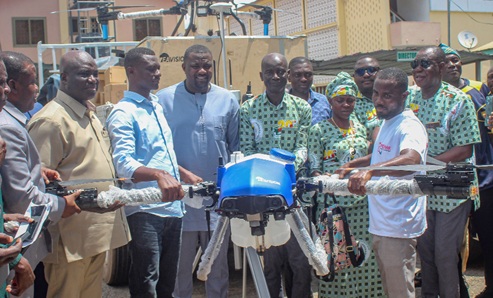
Govt distributes fertilisers, drones to PFAG
The government has distributed 40,000 bags of inorganic fertiliser and five agricultural drones to the Peasant Farmers Association of Ghana (PFAG) to boost food production and support farmers ahead of the major planting season in Northern Ghana and the upcoming minor season in the southern part of the country.
The support, provided under the Feed Ghana Programme, is aimed at increasing productivity, enhancing food security and ensuring that farmers who may not have benefited from the initial fertiliser distribution through district structures receive the needed assistance.
Speaking at a ceremony in Accra yesterday to distribute the inputs, the Minister of Food and Agriculture, Eric Opoku, said the government had already commenced the nationwide distribution of fertilisers to all agricultural production constituencies across the country.
He explained that by the end of the week, each of the country’s 276 constituencies would receive 1,500 bags of fertiliser through the District Departments of Agriculture.
He added that registered faith-based organisations and institutions participating in the Institutional Farming Scheme would also benefit from the programme.
Farmer-centred development
Mr Opoku said the event was not merely about the distribution of agricultural inputs but a demonstration of the government’s commitment to placing farmers at the centre of national development.
“We are gathered here to make a statement that the Ghanaian farmer matters, that the farmer remains central to our food security and that the transformation of Ghana’s economy must begin from the soil, from the farm and from the hardworking hands of our farmers,” he stated.
He stated that the fertilisers and drones represented tools of productivity, hope and investments in food security, job creation, increased farmer incomes and national prosperity.
The minister explained that the 40,000 bags of fertiliser would be distributed through PFAG to its members, particularly those who might not have had access to allocations distributed through district structures.
He said the arrangement underscored the government’s commitment to fairness and inclusiveness under the Feed Ghana Programme.
“It reflects our determination to ensure that no hardworking farmer is left behind simply because he or she could not access support through the first channel of distribution,” he said.
Mr Opoku stated that Ghanaian farmers were not seeking sympathy but timely support, fair access to inputs, reliable markets and opportunities to increase production.
The minister described the drones as practical tools that would support modern farming by helping farmers monitor their farms, detect crop stress, identify pests and diseases early, map farmlands and assess crop performance.
He said the introduction of drone technology signified a new phase in Ghana’s agricultural transformation agenda.
“The drones mark a shift from guesswork to data-driven agriculture, from traditional production practices to precision farming, from low productivity to smart agriculture,” he said.Mr Opoku stressed that the adoption of technology was essential to improving efficiency, reducing losses and increasing yields to meet the country’s food security needs.
Organic fertiliser support
The ministry also distributed 8,000 cartons of organic fertiliser to farmer cooperatives engaged in vegetable production across the country.
The support, according to the minister, formed part of efforts to promote sustainable agricultural practices while improving soil health and crop yields.
He urged beneficiary farmers and organisations to ensure the judicious use of the inputs to maximise productivity during the farming season.
PFAG commends government
The National President of PFAG, Douglas Annor, expressed appreciation to the government for the support and pledged to ensure transparent distribution of the fertiliser and drones to member farmers.
“We are grateful to the government for listening to our plea; together with my team, we will make sure all farmers across all 16 regions registered under PFAG receive their quota through the regional distribution office,” he stated.
