
On June 6, 2026, the Minister of Health suspended the CEO of Komfo Anokye Teaching Hospital (KATH) for two weeks, following the announcement of a temporary closure of Accident-and-Emergency (A & E) at KATH, because the patient intake of 62 had far exceeded the capacity of 30.
Doctors, nurses, pharmacists and indeed all hospital staff went on strike demanding the reinstatement of the CEO. Following the intervention of Otumfuor Nana Asantehene, however, the KATH Staff returned to work on June 9, 2026.
Earlier in April 2025, an altercation between the Minister of Health and the Head of the Accidents-and-Emergency (A & E) Centre of the Tamale Teaching Hospital (TTH) resulted in the dismissal of the CEO. Dissatisfied with what they saw as disrespect and injustice, doctors, nurses and staff of TTH went on strike.
In his article on June 8, 2026, in Graphic-online titled “It’s time to complete the Afari Military Hospital,” George Boateng stated as follows:
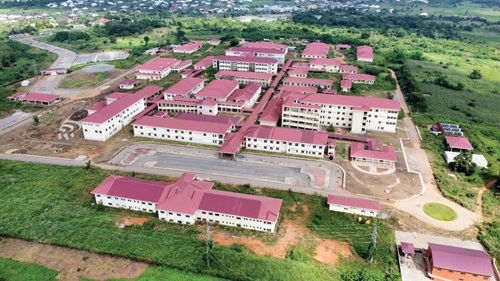
“The recent closure of the Accident-and-Emergency-Centre of the Komfo-Anokye –Teaching-Hospital (KATH) in Kumasi brings into focus the tragedy of a national failure in the operationalisation of the Afari Military Hospital in the Ashanti Region.
The 500-bed capacity facility remains locked away and engulfed by weeds and reptiles while KATH is stretched by volumes of patients and care-seekers from within the region and beyond.”
This took me back to my visit to Kumasi/Afari as published in my September 2, 2022, article in the Daily Graphic titled “Visit to Kumasi: Oseikrom/Garden City,” partly quoted below.
QUOTE
I spent part of the week in the “Garden City of Kumasi, aka “Oseikrom”, on what has almost become a weekend pastime for many Ghanaians. I attended a funeral!
My stay was eventful as it gave me some education, and allowed me to do some cursory comparisons of Accra and Kumasi in a few areas like traffic, discipline/indiscipline and environment.
Apart from driving about 22 kilometres on the Kumasi-Nkawie road to Afari village, the location of the new Kumasi Military Hospital, I also listened to radio discussions on the bloody clash at KNUST between students of University Hall (Katanga) and Unity Hall (Continental).
This was on the heels of a similar violent clash at the University of Ghana, Legon, between Commonwealth Hall (Vandals) and Mensah-Sarbah Hall (Vikings).
Before then, how did the names “Oseikrom” and “Garden City” for Kumasi originate?
“Oseikrom” & “Garden City”
History has it that, until 1701, when the Asante Confederacy was started by Kofi Osei Tutu, later Osei Tutu I, the Oyoko clan, nucleus of the Asante kingdom, was a vassal state of Denkyira, under King Ntim Gyakari.
Obiri Yeboah, who was the uncle of Osei Tutu and leader of the Oyoko clan, died in battle fighting the Dormaas.
Prince Osei Tutu, who had earlier escaped from Denkyira, where he was domiciled, to live in Akwamu, decided to return home to lead his people after his uncle Obiri Yeboah’s death.
His trusted friend and spiritual leader, Okomfo Frimpong Anokye, decided to go with him to Kwaaman, the capital of the Oyoko clan.
On arrival, Okomfo Anokye is said to have planted the “kum” (fig) tree in two locations to test the soil fertility.
One grew luxuriantly and was named “Kum-ase”, meaning under the shade of Kum.
The other “kum” tree died, hence the name “Kum-awu.”
The names Kumase and Kumawu were thus born.
Kumase became Osei Tutu’s capital, with him becoming the first Asantehene with the title King Osei Tutu I.
So people going to Kumasi said in Twi, “mee-kor Osei-krom,” meaning, “I am going to Osei’s town.”
How did the name “Garden City” come about?
In 1961, Queen Elizabeth II of England visited Ghana.
She is said to have been so awed by the greenery, beauty and orderliness of Kumasi on a visit there that she called it the “Garden City!” of West Africa. Kumasi was also home to a variety of flowers and species of plants.
“Katanga vs Conti”
One of the major topics that dominated the airwaves during my visit to Kumasi was the ugly clash between students of University Hall (Katanga) and Unity Hall (Continental).
In the clash between the two rival halls during the hall week celebration of University Hall, 12 students were injured and hospitalised, 12 vehicles were damaged, and university/personal property destroyed by the rampaging students.
Incidentally, this was soon after a similar violent clash at the University of Ghana, Legon, between students of Commonwealth Hall and Mensah-Sarbah Hall.
It is difficult to understand why students who are being trained as the next generation of future leaders for Ghana should think that causing harm to fellow students, vandalising and destroying the university, as well as personal property, is what they have gone to the university to learn.
Many of these students are dependents of poor and struggling parents who are sacrificing everything just to invest in the future of their children through tertiary education.
Dr Samuel Johnson, who in 1755 produced the first English-language dictionary, said, “The supreme end of education is expert discernment in all things; the power to tell the good from the bad, and the genuine from the counterfeit.
But above all, to prefer the good and the genuine to the bad and the counterfeit!
Is this noble objective what these violent university students are aiming for?
Unfortunately, in some discussions, reference was made to January 7, 2021, when Parliamentarians reduced the chamber to a boxing/wrestling arena in the full glare of Ghanaians and the world. Some opine that it is earlier inaction against such vandalism in the universities which graduated into the violence in Parliament.
This unfortunate/criminal trend must be reversed.
We cannot build a nation on indiscipline!
The earlier we stop this canker of vandalism/violence in our universities, the better for the future of Ghana!
UNQUOTE
Summary
My intention before leaving Accra for a funeral in Kumasi in the second weekend in June 2026 was to visit Afari Military Hospital following reports of the virtual abandonment of the project since my last visit in 2022.
However, seeing the pictures of the facility on television during the week, I saw more than enough not to warrant the arduous journey to Afari, especially in the rainy season and the effect on the roads.
Lamenting the effects of the current floods in Accra on his return from his trip to the UK and Belarus, the President once again bemoaned the loss of our cultural values.
He states that “our values are eroded. We don’t care anymore!” How right he is!
Otherwise, why the confrontational, arrogant and disrespectful approach to solving a problem everybody wants solved, by attacking and suspending CEOs of teaching hospitals, as we have seen with TTH and KATH? Scapegoating CEOs and blatantly showing power for systemic institutional problems that bedevil our health ecosystem is certainly not good leadership. Leadership is not showing power!
Calm, sober, respectful dialogue in our collective quest to solve our problems of health/sanitation should be preferred to abrasive and disrespectful sacking of CEOs. Our cultural values, which the President referred to, enjoin us to respect our elders even in disagreement.
Remember the Latin phrase “festina lente,” meaning “hasten slowly!” While wanting to proceed with speed, we must be careful to avoid obvious mistakes.
The other saying is, “more haste, less speed!”
Unlike Accra, which has major hospitals, including Korle Bu, 37 Military Hospital, Police Hospital and Ridge Hospital, KATH is the only major hospital in Kumasi, and probably the Middle Belt.
Afari Military Hospital is a veritable resource going to waste, which must be revived with immediate effect.
This way, the CEO of KATH will not be suspended for taking a medical/management decision.
Leadership, lead by Example/Humility/Integrity! Fellow Ghanaians, WAKE UP!
The writer is a
former CEO, African Peace Support Trainers Association
Nairobi, Kenya
Council Chairman
Family Health University College
Accra
