
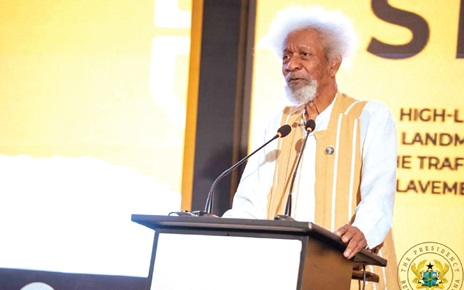
Move beyond reparation rhetorics - Prof. Soyinka urges African leaders
A nobel laureate, writer and playwright, Prof. Wole Soyinka, has urged African leaders to adopt active and impactful strategies in the commemoration and push for reparatory justice.
Speaking at the opening session of the High-Level Consultative Conference on Reparatory Justice in Accra last Thursday, Prof. Soyinka stressed that the continent needed to go beyond “performances, discussions, rhetorics, even the economic aspects” of engaging with its slave trade past.
“Let us move mentally and practically towards dynamising the commemoratives which exist.
We have to move now beyond the performances, the discussions, the rhetoric, even the economic aspects of a retrieval of an egalitarian relationship between us and them.
“We have to recognise that even our mental condition is important in the diaspora,” Prof. Soyinka said.
Addressing what he described as a recent visa policy by an unnamed country, the 90-year-old laureate cautioned that restricting visas for nationals whose governments supported reparatory justice would amount to self-isolation.
“Mr President (John Dramani Mahama), Sir, I hope you realise that you placed both yourself and your citizens in potential quarantine. But you’ve been good about me, because now I see before me all international community out of the quarantine,” he said.
Prof. Soyinka said the policy emerged shortly after “historic resolution” adopted by the United Nations on March 25 this year, and described it as a missed “golden opportunity to re-examine a divisive history, a divisive spate which went for centuries”.
He questioned how any state could penalise a quest for anything, voiced or unvoiced, especially when it related to memory,
“We all live within a commemorative environment, negative and positive.
We commemorate all the time,” he stated
Mental rehumanisation
Prof. Soyinka linked the persistence of modern slavery and irregular migration to “inorganic development” on the continent and to leadership failures.
He condemned forms of leadership in parts of the continent where citizens continued to be regarded as slaves.
Prof. Soyinka also pointed to African migrants drowning in the Mediterranean “simply because they’re looking for a different economic kind of liberation” as a “commemorative also in a negative mode”.
The famed laureate affirmed that any means that enabled Africa to recover collectively the rehumanisation not just of the present, but even of memory, was essential to the collective development of those who had been traumatised as a people.
Modern slavery
Prof. Soyinka called for efforts to address the kidnapping of people and the desire of African youth to cross the Mediterranean Sea in search of greener pastures.
“I refer to the extant slave markets which still exist on this continent. I refer to the kidnapping of schoolchildren who were sent to these institutions of learning, who end up being kidnapped because there are ready markets for them,” he said.
Citing Nigeria’s Department of the Diaspora, Prof. Soyinka revealed that chartered rescue planes, which had managed to retrieve nationals from the slave markets and brought back to Nigeria, had been deployed.
He described returnees’ first act as “kneeling and kissing the ground from which they have been taken”.
“The most pernicious of these inequities are the children, the youth, who until today have been kidnapped and sent to the slave markets,” he added.
