
Govt urged to adhere to counterpart funding obligation
OPE for Future Generations (HFFG), a health-based non-governmental organisation (NGO), has called on the government to urgently honour its counterpart funding of vaccines to the Global Alliance for Vaccines and Immunisations (GAVI) to avert a possible shortage of vaccines for routine immunisation.
Ghana's total vaccine cost for 2025 is projected at $47.2 million. While the Global Alliance for GAVI is expected to contribute $25.2 million, the government of Ghana is required to co-finance with $16.3 million.
According to the NGO, the government’s delay in releasing its counterpart funding risks interrupting routine immunisation services, leaving millions of children vulnerable to preventable diseases including the six killer diseases and many more.
The Executive Director for HFFG, Cecelia Lodonu-Senoo, said Ghana had delayed in meeting its payment timeline to GAVI at the first quarter of 2025.
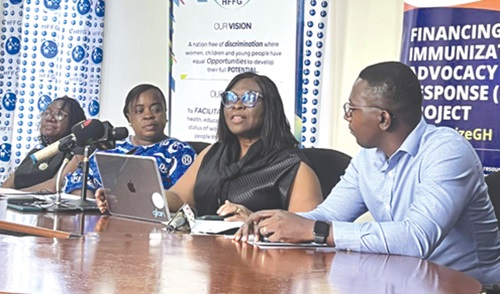
At a press conference in Accra recently, she noted that the critical importance of the timely release of funds, would help prevent stockouts, mitigate the risks of preventable disease outbreaks, while preserving the real value of budget allocation.
“As of the second week of June, the government has made no commitment to its co-financing obligation; Ghana stands to experience shortages of vaccines since co-financing payments are still pending,” she said.
Mrs Lodonu-Senoo noted that the delays in co-financing payments threatened the gains made in immunisation, with ripple effects on child welfare, public health security and economic productivity.
“Stockouts compromise Ghana’s gains in vaccine-preventable disease control, reduce public trust in the health system, and can result in outbreaks of several diseases,” she said.
Co-financing obligation
The Director of Programmes, HFFG, Nancy Ansah, who also addressed the media, said: “Currently, the government has made no commitment to its co-financing obligation” adding that Ghana stands to experience shortages of vaccines since co-financing payments are still pending.
She stated that delays in co-financing threatened immunisation gains made, with ripple effects on child welfare, public health security and economic productivity, adding that stockouts compromised Ghana's gains in vaccine-preventable disease control, reduced public thrust in the health system and could result in outbreaks of several diseases.
While Ghana delayed in meeting its co-financing obligations in 2023, it defaulted in paying its co-financing to GAVI in 2014, 2016 and 2018 leading to vaccine shortages that contributed to significant public health challenges.
Giving examples, she said in 2022, the country recorded over 120 measles cases in the Northern Region due to vaccine stockouts, while a 2019 polio outbreak, being Ghana's first in a decade, was linked to low vaccination coverage and surveillance gaps.
These events, she said, highlight the critical need for timely, sustained domestic financing for immunisation to prevent future outbreaks and protect public health, saying that Ghana must fulfil its already delayed 2025 vaccine co-financing obligations to prevent imminent stockouts.
Mrs Ansah said while the uncapping of the National Health Insurance Levy (NHIL) was commendable, the GH₵10.7 billion allocation was inadequate, especially as the NHIL coverage expanded.
She emphasised the need for the government to explore innovative financing models to close funding gaps in immunisation and public healthcare delivery.
She said Ghana needed a ring-fenced emergency preparedness fund to support surveillance, health system resilience and rapid outbreak prevention.
In line with the Abidjan Declaration, it is anticipated that the government would commit to its obligations being a signatory to the declaration.
She added that the country’s continued reliance on external funding had strained its immunisation infrastructure, underscoring the importance of timely co-financing, domestic resource mobilisation and strategic partnerships to strengthen the immunisation gains.
Writer’s email:
