
The Ministry of Health has ordered seven health professionals from the Police Hospital, the Greater Accra Regional Hospital and the Korle Bu Teaching Hospital named in a report following an inquiry into the death of a road accident victim to face disciplinary action.
Dr Aida Druante, Dr Genevieve Adjah, Joy Daisy Nelson and Salamatu Alhassan, all of the Korle Bu Teaching Hospital (KBTH), along with Dr Nina Naomin Eyram and Akosua B. Turkson of the Greater Accra Regional Hospital (GARH) and Dr Anne-Marie Kudowo of the Police Hospital are to face disciplinary actions for their roles in the death of Charles Amissah, a victim of a hit-and-run road accident.
Charles Amissah, an engineer who worked with Promasidor in Accra, died of the injuries he suffered in a hit-and-run road accident as a car knocked him off his motorbike as he rode from work in February this year.
The independent investigation, chaired by renowned pathologist and a former Director-General of the Ghana Health Service, Prof. Agyeman Badu Akosa, found that Amissah did not die instantly from the road accident injuries, but from prolonged, preventable blood loss (exsanguination) due to failure of emergency medical care.
Consequently, directives have been issued to authorities of the respective hospitals and regulatory bodies to act swiftly.
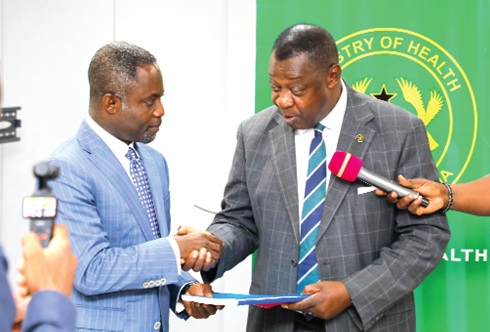
At a news briefing in Accra on Wednesday [May 6, 2026] during the presentation of the committee’s report, the Minister of Health, Kwabena Mintah Akandoh, announced immediate steps to ensure accountability and prevent future tragedies.
Beyond sanctions, the minister emphasised ongoing and planned reforms to strengthen emergency care, including the rollout of a national electronic bed management system to improve patient allocation and reduce delays.
"The most important aspect is for us to be able to avoid the avoidable deaths we have witnessed,” Mr Akandoh said.
He also announced that the Ghana Armed Forces Critical Care and Emergency Hospital would be opened for public use as a national resource.
Reaffirming the government’s commitment, the minister stressed that the goal was not just to publish findings but to implement recommendations that would prevent avoidable deaths and improve Ghana’s emergency healthcare system.
"I want to repeat and assure the committee that your work will not be in vain. We'll endeavour to implement all the recommendations in the best interest of Mother Ghana," he added.
Report
The report said Amissah was alive at every stage — from the accident scene to the Police Hospital, Greater Accra Regional Hospital and Korle Bu Teaching Hospital — but none of those facilities provided timely life-saving intervention such as bleeding control, IV fluids or blood transfusion.
The report stated that pathology confirmed a “slow death from medical neglect”, emphasising that early intervention at any point could have saved his life.
The fatal injury — a deep arm wound damaging major blood vessels — was survivable with basic emergency care, the report said.
The committee, formed by the Minister of Health on February 23, also recommended systemic reforms in Ghana’s emergency care system.
Presenting the report, Prof. Akosa said the death of Amissah had not only exposed a tragic chain of missed opportunities, but also forced a national reckoning, one that the investigative committee insisted must lead to real, lasting changes.
"The pathology confirms a slow death from medical neglect, and was not from the instant trauma.
What it means is that, if at any of these facilities, there had been medical intervention, Charles Amissah could have survived," he said.
"The post-mortem report was very pertinent.
The significant post-mortem findings were that there was a deep laceration injury of the right upper arm, blood vessels and muscles.
Charles Amissah had a comminuted open fracture of the right upper humerus," he stated.
In the aftermath of its findings, the committee’s recommendations read less like technical directives and more like a blueprint to prevent another life from slipping away under similar circumstances.
At the heart of it is a simple but urgent principle: no patient in a life-threatening condition should ever be turned away without immediate care.
But beyond individual accountability, the report indicated that the problem ran deeper into the very structure of emergency care in Ghana, with one of the most significant proposals to create a national emergency care fund.
Under this system, any patient picked up in critical condition would be guaranteed immediate treatment — whether at a public or private facility — without delays over payment.
The first 24 hours, the committee argued, were often the difference between life and death, and no hospital should hesitate to act because of financial uncertainty.
Alongside this was a call for a mandatory policy requiring all hospitals to stabilise emergency patients before any referral.
The committee envisioned a system where the nearest facility became the first line of defence, not a checkpoint that passed responsibility along.
The report highlighted the need to bring the Ghana Armed Forces’ Critical Care and Emergency Hospital fully into public use, transforming it into a shared national asset capable of easing pressure on civilian hospitals.
Additionally, the committee warned against allowing the report to gather dust, stressing the need for a central governance system to ensure that reforms were actually implemented and enforced.
Committee members
The committee, tasked to examine the sequence of events, decision-making processes, and any factors that might have contributed to delays in emergency care, included Technical Advisor at the Ministry of Health, Dr Koku Awoonor-Williams; Consultant of Emergency Medicine, Dr Conrad Buckle; Fellow in Emergency Medicine at Korle Bu Teaching Hospital, Dr Henry Kwasi Bulley,
The rest were Senior Emergency Medicine Physician at the University of Ghana Medical Centre, Dr Kwame Ekremet; Emergency and Critical Care Nurse, Faustina Excel; Emergency and Critical Care Nurse, Gertrude Nana Konadu Agyeman; Head and Director Legal of the Ministry of Health, Inua I. Yusu, and Senior Administrative Manager at the Ministry of Health, Dacosta Osei Agyekum.
