
NaCCA launches Chinese language curriculum
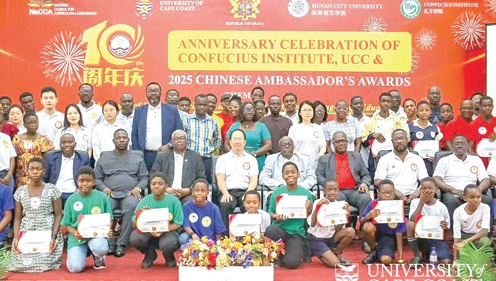
The National Council for Curriculum and Assessment (NaCCA) has officially launched a Chinese language curriculum for basic, junior high and senior high schools in Ghana, as the Confucius Institute at the University of Cape Coast (UCC) celebrated its 10th anniversary alongside the 2025 Chinese Ambassador’s Awards ceremony.
The event, held on the theme “A decade of cultural exchange and excellence in Chinese Language education,” brought together education stakeholders, traditional leaders, diplomats and academics.
In a speech on behalf of the Director-General of NaCCA, Prof. Samuel Ofori Bekoe, the Board Chairman of NaCCA, Prof. Vincent Assanful, described the occasion as a watershed moment in Ghana’s education history and international relations.
He said the event went beyond celebration, noting that it was about operationalising a vision to prepare Ghanaian learners for competitiveness in the modern global economy.
Prof. Assanful explained that literacy in the 21st century had expanded beyond proficiency in one’s mother tongue and English, stressing that Ghanaian learners should now acquire cultural intelligence and multilingual competencies to thrive globally.
Curricula
He noted that NaCCA’s role extended beyond regulation to strategic partnership in positioning Ghana’s future workforce within the global economic space.
Prof. Assanful said NaCCA’s mandate to develop relevant, standards-based and forward-looking curricula informed its decision to formalise the teaching of the Chinese language within Ghana’s basic education system, particularly in recognition of China’s growing global economic influence and its status as a key development partner to Ghana.
According to him, the curriculum development process could not be done in isolation, making the technical and cultural expertise of the Confucius Institute at the UCC critical.
He revealed that NaCCA had, over the past months, engaged in intensive technical collaboration with the Institute, moving beyond appreciation of the language to the rigorous science of pedagogy.
Prof. Assanful disclosed that the resulting draft curriculum was competency-based, focusing on communicative proficiency and functional literacy rather than rote memorisation; contextually adaptive, ensuring alignment with Ghanaian values and realities; and structurally sound, benchmarked against the Hanyu Shuiping Kaoshi (HSK) standards, while fitting seamlessly into Ghana’s Common Core Programme.
Education and culture
The Central Regional Director of Education, Dr Juliet Dufie Otamie, highlighted the role of education and culture in strengthening Ghana–China relations.
She noted that education remained a powerful tool for opening doors and creating opportunities for young people, describing the Confucius Institute as a platform that has empowered young people through knowledge, skills and global exposure.
The Ghana Director of the Confucius Institute, Prof. Emmanuel Amo Ofori, traced the institute’s journey from its conceptual beginnings in 2008 to its approval by Hanban in December 2015 and its official launch in June 2016.
The acting Vice-Chancellor of the UCC, Prof. Dennis Worlanyo Aheto, described the celebration as a moment of pride, joy and reflection on a decade of growth, partnership and economic opportunity fostered through the Confucius Institute.
He noted that the institute had become one of the university’s most impactful international collaborations, contributing significantly to human capital development and global engagement.
Awards
As part of the ceremony, citations were presented to Prof. Worlanyo Aheto and former Vice-Chancellors, Prof. Domwini Dabire Kuupole, Prof. Joseph Ghartey Ampiah and Prof. Johnson Nyarko Boampong, for their visionary leadership.
A special citation was also awarded to Prof. Kwadwo Opoku Agyemang, the first Director of the Confucius Institute at the UCC, in recognition of his pioneering efforts.
Mafaatih Wunnam Alidu Cotachi was recognised as the African champion for the global competition for primary students.
Kweku Henaku Otsin emerged as the first runner-up in the National Competition for Primary School Students held at the University of Cape Coast (UCC), earning a cash prize of $400.
Meanwhile, Michelle Yeboah Nyamah was the second runner-up, receiving a cash award of $200, among other prizes presented at the competition.
