
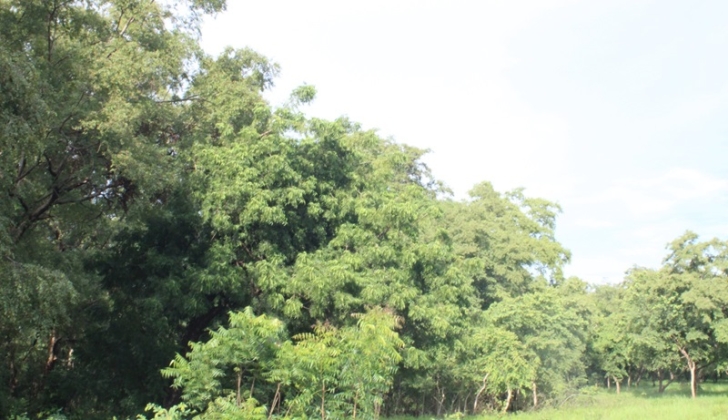
Towering trees formed a dense canopy overhead, filtering the scorching sunlight into dappled patterns on the floor.
The noticeably cooler and humid air carried the earthy scent of decaying leaves and damp soil.
An array of birds flapped their wings and chirped heartily, with their melodious tunes filling the air in the forest environment.
This was the sight that greeted me when I got to the Yiwagu community sacred grove on the morning of October 15 this year.
Sacred groves are patches of natural forest or woodland preserved by local communities due to their spiritual and cultural significance.
In Ghana, these groves are scattered across the country, with estimates suggesting there are roughly 2,500 sacred groves nationwide, varying widely in size from a few hectares to larger tracts of forest.
One of such sacred groves is the one located at Yiwagu, a farming community of about 500 residents, which is about 15-minute drive from Savelugu in the Savelugu Municipality in the Northern Region.
Resting on 12 hectares of land, the sacred grove has been preserved for over 37 years. It hosts the community shrine known as Maltiti, to wit, “make it well for us.”
Maltiti is believed to be the spiritual embodiment of the people. People from far and near carry their burdens to the shrine, hoping to have them lifted.
If it was not couples seeking the fruit of the womb, it was litigants seeking favour to win their court cases.
“When there is drought, we make sacrifices to our ancestors through Maltiti for rains to fall, and it happens,” Gundana Abubakari Wmbei, one of the attendants, said.
To give Maltiti peace of mind, it is forbidden for anyone to enter the sacred grove to cut a tree or hunt any animal.
“If anyone enters the sacred grove and cuts a tree or hunts an animal, they will be bitten by a snake or a strange disease will attack them; and until they come back to appease the gods, they will never be healed,” he said.
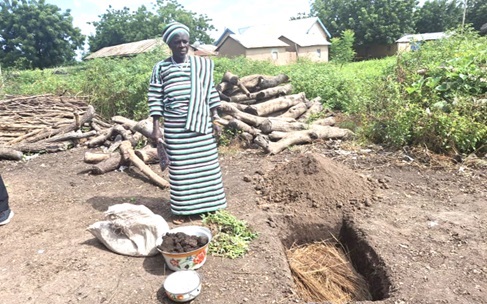
Meanwhile, 58-year-old Shaibu Pawuni, the community herbalist, sees the sacred grove as the one-stop shop for endangered medicinal plants needed for the preparation of herbal concoctions to heal the sick and afflicted.
“I inherited the role of community herbalist from my grandmother, and I get endangered herbs from this sacred grove to treat people,” she added.
Science behind sacred groves
Beyond the traditional beliefs the people of Yiwogu and other local communities have in the sacred groves are their immense ecological and climate benefits.
By preserving the sacred grove where indigenous tree species and rich biodiversity thrive, the people of Yiwagu are contributing directly to save the world’s 8.2 billion population.
In the face of the global climate crisis, sacred groves are emerging as vital allies in environmental conservation and climate resilience by serving as critical ecological havens for climate change mitigation and adaptation.
Their role in carbon sequestration and regulating local microclimates cannot be overemphasised.
Aside from serving as a refuge for biodiversity, these natural sites are a hub of endemic plant and animal species.
They also act as natural reservoirs of genetic diversity.
Again, sacred groves provide critical pockets of forest cover that help to maintain ecological balance, especially in the wake of increasing deforestation and land degradation that are exacerbated by climate change.
Paris Agreement
It is in recognition of the environmental and cultural value of sacred groves that the government incorporated provisions for their preservation within its climate action frameworks, including its Nationally Determined Contributions (NDCs) under the Paris Agreement.
The NDCs emphasise sustainable forest management, biodiversity conservation, and community-based natural resource management as key strategies to reduce greenhouse gas emissions and build climate resilience.
While the NDC does not single out sacred groves explicitly in all documents, it acknowledges the role of community-managed forest areas, which include sacred groves, in carbon sequestration and ecosystem services.
Specifically, Ghana’s Forestry Development Master Plan (2016–2040) identified sacred groves as critical conservation sites that require protection and integration into broader landscape restoration efforts.
Despite their recognised importance, sacred groves and shrines face several challenges that threaten their existence and capacity to provide essential ecosystem services. These challenges range from increasing population pressures, expansionary agricultural practices, to illegal mining.
The Executive Director of Regional Advisory Information Network Systems (RAINS, a climate change non-governmental organisation in northern Ghana, Hardi Tijani, said the size of sacred groves in northern Ghana was diminishing because of encroachment by farmers and wild fires
Global efforts
At the 30th Conference of Parties (COP30) of the United Nations Framework Convention on Climate Change (UNFCC), held in the Brazilian city of Belem this year, the Tropical Forest Forever Facility (TFFF) was launched.
The TFFF is designed to provide long-term, predictable finance to countries that conserve tropical forests by paying them for verified forest conservation.
The initiative aims to mobilise $125 billion in blended public and private capital to provide about $4 billion annually in performance-based payments for maintaining low deforestation rates.
One striking feature of the TFFF is the provision that ensures that at least 20 per cent of payments go directly to Indigenous Peoples and Local Communities (IPLCs).
The Global Lead, Africa Centre for Nature-based Climate Action (AC4NCA), Samuel A. Jinapor, described the TFFF as a game-changer for Ghana and other African countries.
“TFFF’s dedicated 20 per cent allocation for local communities represents a paradigm shift: for the first time, indigenous peoples and forest-edge communities receive direct, predictable benefits.
These funds can support alternative livelihoods, payments for ecosystem services, sustainable agriculture, and community-led restoration, ensuring that conservation aligns with social development,” he said.
Call to action
While Ghana looks forward to taking advantage of this fund for forest preservation, it is important for local resources to be mobilised to help protect sacred groves from destruction.
Ghana is yet to submit the third edition of NDCs (NDC 3.0) document to the UNFCCC as revision and consultations are ongoing.
Given the crucial role sacred groves play in conservation, there is the need to include traditional authorities in climate action planning.
NDC 3.0 must recognise that areas with traditional protection, like sacred groves, have demonstrably higher biodiversity and should be considered valuable conservation tools.
To that effect, it is important to involve traditional authorities, landowners, and communities in shaping and implementing climate action, including forest management and benefit-sharing.
