
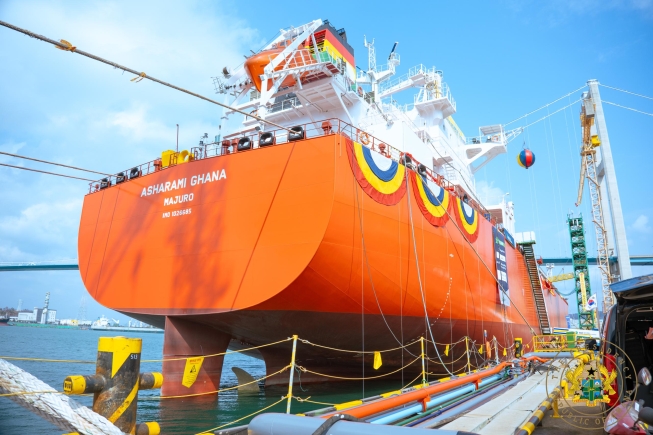
President John Dramani Mahama has commissioned a modern Liquefied Petroleum Gas (LPG) vessel in South Korea, describing it as a strategic asset that will strengthen energy security and support the transition to cleaner energy across Africa.
The commissioning ceremony, held on Thursday, March 12, 2026, at a major shipyard in South Korea — a country widely recognised for its maritime engineering expertise — marked the official launch of the MT Asharami Ghana, a dual-fuel, fully refrigerated LPG carrier.
Addressing a gathering of dignitaries, industry leaders and partners, President Mahama said the event represented more than the launch of a single vessel.
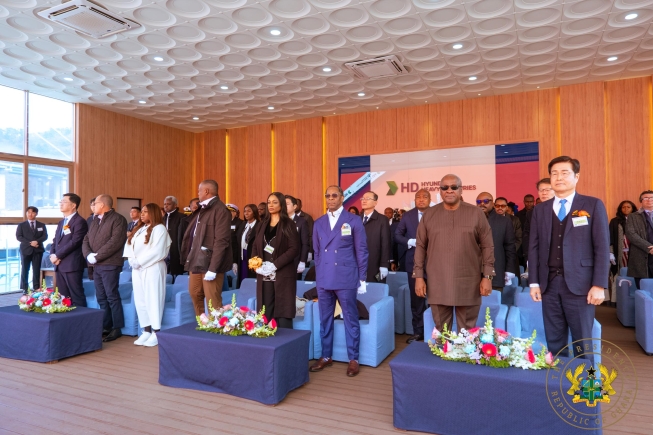
He explained that it symbolised a significant step in strengthening the infrastructure that supports the global LPG supply chain.
“For countries such as Ghana and many across Africa that rely partly on LPG imports to complement domestic production, the expansion of global shipping capacity is essential,” President Mahama said.
He added that, “It enhances supply security, improves reliability, stabilises pricing through more efficient logistics, and creates opportunities to diversify supply sources across international markets.”
Strategic boost for regional energy supply
President Mahama highlighted the collaborative effort behind the project and praised the shared vision of stakeholders committed to ensuring safe and responsible energy distribution.
He said through the West Africa Gas Limited (WAGL) Energy initiative, the vessel forms part of a strategic fleet designed to support the region’s evolving energy needs.
According to the President, the deployment of the vessel marks a new chapter in regional energy logistics and will help expand access to reliable and cleaner energy across West Africa.
Role in cleaner energy transition
President Mahama underscored the critical role of LPG in the global shift towards cleaner energy, particularly for millions of households across the African continent.
He noted that LPG offers a cleaner alternative to traditional fuels such as charcoal, firewood and kerosene, helping to reduce indoor air pollution while contributing to environmental sustainability through lower levels of deforestation.
“Through strategic investments and forward-looking partnerships, such as the one we celebrate today, we are taking practical steps to enhance energy security for Ghana, West Africa, and Africa as a whole,” he stated.
President Mahama said, “These efforts contribute to building a just and inclusive energy transition that benefits present and future generations.”
Strengthening Ghana’s LPG supply
Providing further context on Ghana’s energy landscape, the President revealed that the country currently produces about 50 per cent of its LPG needs locally and relies on imports to meet the remaining demand.
He said the commissioning of the MT Asharami Ghana would strengthen the capacity to transport LPG safely, efficiently and on a larger scale.
“This LPG vessel will strengthen our collective ability to transport LPG safely, efficiently, and at scale,” President Mahama explained.
He added that, “In doing so, they will help ensure that businesses, industries, and households can depend on modern energy services that support economic growth and improve quality of life.”
Commendation for partners
President Mahama commended the leadership, technical expertise and strategic foresight demonstrated by Sahara Group, WAGL Energy and other partners involved in the project.
He said their commitment illustrates what can be achieved when innovation, investment and collaboration come together to bridge infrastructure gaps and unlock sustainable economic opportunities across Africa.
The commissioning, he added, also highlighted the enduring value of international cooperation and the strength of partnerships between Africa and its global partners, built on mutual respect and a shared commitment to sustainable development.
President Mahama expressed hope that the MT Asharami Ghana would serve as a symbol of progress and inspire further investment, innovation and collaboration across Africa’s energy value chain.
“Together, we can build the infrastructure, partnerships, and policies necessary to secure a sustainable and prosperous energy future for our continent,” he said.
