
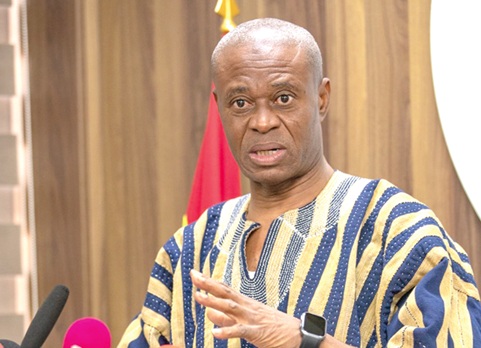
The government has introduced a new premium framework for public land leases. Under the new framework, a minimum of 70 per cent of the assessed market value of public land would be paid upfront as a premium, while the remaining 30 per cent is structured over the tenure of the lease as ground rent.
The Deputy Minister of Lands and Natural Resources, Alhaji Yusif Sulemana, who made this known, said the reform was intended to promote value for money and enhance revenue generation for the state.
Additionally, he said, the reform would ensure that public lands were allocated in a manner consistent with national economic interests.
He stated this at a media briefing in Accra yesterday to announce key reforms in the land sector.
Alhaji Sulemana explained that the ministry was implementing that reform following the outcome of the Review of the Lease of Public Lands Committee’s report and the approval of the recommendations by Cabinet.
Internal processes
Alhaji Sulemana said the ministry had undertaken a comprehensive review of the Lands Commission’s internal procedures governing the allocation of public lands.
He said the revised process clearly defined the stages involved in processing public land applications, all of which were anchored on strengthening internal checks and verification mechanisms, as well as enhancing transparency, accountability and traceability in decision-making.
He explained that under the revised framework, no public land would be allocated by the Lands Commission without the prior written approval of the Minister of Lands and Natural Resources.
"This measure will strengthen ministerial oversight and ensure alignment with national policy objectives in the management of public lands," he said.
Market value
In the area of compilation of land market values for various estates, Alhaji Sulemana said the ministry, working with the Lands Commission, had compiled reliable land market values for various estates across the country.
The deputy minister said those market values would be published on the official website of the Lands Commission to provide a transparent reference point for assessing land premiums and determining value-for-money considerations in public land allocations.
Again, he said, there had been a revision of premium payable on public lands.
Public Land applications
The deputy minister added that one of the key recommendations approved by Cabinet was the publication of all public land applications by individuals, companies and organisations for the review period.
"In line with this directive, the Lands Commission will publish both completed and uncompleted public land applications reviewed on a region-by-region basis, beginning with the Greater Accra Region.
"These lists will be made available on the official websites of the Ministry of Lands and Natural Resources and the Lands Commission in the coming weeks," he said.
Ban lifted
Alhaji Sulemana reiterated that the temporary suspension of services of the Lands Commission relating to the leasing, processing and regularisation of public lands had been lifted, and that services had resumed with immediate effect.
"However, these services will be carried out strictly in accordance with the new reforms and procedures introduced by the ministry to ensure transparency, accountability and value for money in all public land transactions," he said.
He further stressed that the Lands Ministry had initiated the procurement process for the national digitalisation of the country's land administration system.
"This major reform is intended to modernise land administration processes, drastically reduce human interference and promote greater transparency, efficiency and accountability in the management of land records and transactions," he added.
Alhaji Sulemana added that to support the implementation of the initiative, the ministry had secured 100 per cent retention of the Lands Commission’s internally generated funds.
He said 67 per cent of these funds had been earmarked to fund the national digitalisation project, which would transform the delivery of land services across the country.
