
President Donald Trump has told Congress that US hostilities with Iran have "terminated" during an ongoing ceasefire, as he argued he did not need to meet a deadline for legislative approval of the war.
By law, a US president must receive Congress' approval within 60 days of notifying lawmakers of military action, or else cease hostilities.
But in a letter to congressional leaders, Trump said he does not have to comply with that war powers act as the ceasefire agreed with Iran last month had paused the clock on any such obligation.
The US and Iran have not yet reached a longer-term peace deal via talks, though Iranian media reported a new proposal from Tehran sent via Pakistan on Friday.
On the 60th day since he formally notified Congress of strikes against Iran, Trump wrote to congressional leaders on Friday: "There has been no exchange of fire between the United States Forces and Iran since April 7, 2026.
"The hostilities that began on February 28, 2026 have terminated."
According to Iranian state news agency IRNA, a proposal from Tehran for negotiations with the US was sent to Pakistan intermediaries.
The news agency did not publish the details, and it's unclear if the proposal has reached the US.
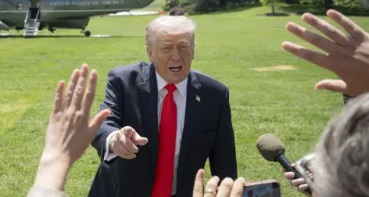
But Trump told reporters: "We just had a conversation with Iran. Let's see what happens. But, I would say that I am not happy."
He said a deal has been hard to reach in part because Iranian leadership was "very confused", after a number of its top military officials were killed in the war.
Trump said he was briefed with options by US Central Command on Thursday, ranging from "blast the hell out of them and finish them forever" to "make a deal".
Later on Friday, Trump said: "they're not coming through with the kind of deal that we have to have.
"And we're going to get this thing done properly. We're not going to leave early and then have the problem arise in three more years."
Meanwhile, the US Treasury has issued a notice warning that any individual or company that pays Iran a "toll" for passage through the Strait of Hormuz was at risk of violating US sanctions.
The key shipping channel is still effectively closed - causing economic impacts around the world.
In Congress, lawmakers have faced mounting questions about whether they intend to schedule a vote in each chamber to decide whether the war should receive formal authorisation.
The relevant US law, the 1973 War Powers Resolution, makes certain requirements of a president "within sixty calendar days" of their use of US armed forces in combat.
It requires a president to end the use of those forces unless Congress makes a formal declaration of war or allows the president an extension, up to 30 days in length, for the "prompt removal" of troops.
The law was passed in 1973 to limit the ability of then-President Richard Nixon to continue waging war in Vietnam.
Defence Secretary Pete Hegseth argued before a congressional hearing on Thursday that the clock had paused on the deadline to seek legislators' approval.
Democratic Senator Tim Kaine responded: "I do not believe the statute would support that."
Democratic-led attempts in both chambers of Congress to constrain Trump in the case of Iran have repeatedly failed.
Most Republicans have opposed the Democratic efforts, though some have indicated they might reconsider their positions after the 60-day mark.
Asked on Friday about seeking authorisation from Congress, Trump told reporters, "no other country has ever done it".
"Most people consider it totally unconstitutional," he said.
The Trump administration's interpretation of the War Powers Resolution has been questioned by some experts.
Professor Heather Brandon-Smith, from Georgetown University Law in Washington DC, said that even if a ceasefire was legally in effect, it would not stop the clock.
"A ceasefire is not a permanent end to the conflict," she said. "To my mind, a permanent end to the conflict is what would actually sort of close up the 60 days."
The courts or Congress, she said, would be the only means to stop the war if the Trump administration continues the conflict.
The conflict began when the US and Israel launched wide-ranging strikes on Iran, killing the country's supreme leader. Iran responded by launching attacks on Israel and US-allied states in the Gulf.
The US and Israel have led Western opposition to Iran's nuclear programme, claiming the country is seeking to develop a nuclear bomb, which Tehran has denied.
