
Fugu, the smart casual wear, is an age-old traditional apparel worn across the country and popularised by successive Presidents of the country’s four republics.
It is the attire the first President of Ghana, Dr Kwame Nkrumah, wore when he declared Ghana’s independence from colonial rule on March 6, 1957.4
Successive Presidents, namely Dr K. A. Busia, Dr Hilla Limann, J. J. Rawlings, J. A. Kufuor, Prof. J. E. A. Mills and Nana Addo Dankwa Akufo-Addo, all wore the unique Ghanaian fabric at both official functions and casual ceremonies.
In the 1990s, in particular, President Rawlings gave it a new perspective, wearing the smock over long-sleeved shirts.
That fashion caught on with the public.
President John Dramani Mahama has been an ambassador of the rich Ghanaian apparel as he showcases it at high-level global conferences, including the United Nations General Assembly.
Controversy
The authentic Ghanaian fashion fabric attained a new level of international appeal this week when President John Dramani Mahama adorned the yarn-woven costume as he touched down in Zambia for a three-day state visit.
Zambians, apparently unfamiliar with the costume, described it as a blouse in a light-hearted joke.
The joke about the Ghanaian President’s traditional fashion sense rather triggered a national rally back home in Ghana, with an uproar culminating in a spontaneous national fugu Friday wear across public and private sector workplaces, public spaces and social events.
Indeed, a social group announced a full sponsorship of a photoshoot at the Black Star Square.
Social media uproar
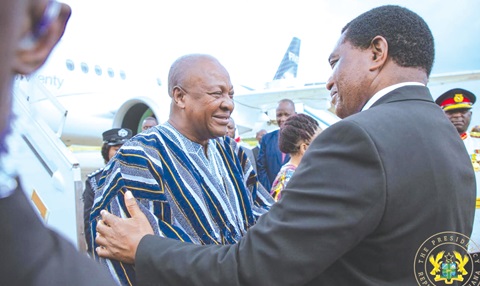
President Hakainde Hichilema of Zambia had put together a colourful guard of honour parade at the Kenneth Kaunda International Airport (LUN) in Lusaka last Wednesday to welcome President Mahama for the three-day state visit to Zambia.
Dressed in an immaculate European suit and red flying tie, with ministers and other high-ranking state officials appearing the same, the expectation of many Zambians and the immediate crowd at the airport was to see President Mahama in a similar Western dress code.
However, it was all shock when President Mahama stepped out of the special private jet sporting a colourful, bold striped fugu in the company of the First Lady, Lordina.
His choice was a deliberate display of Ghanaian heritage and a quiet assertion of Pan-African solidarity on the continental stage.
Unfortunately, some Zambian social media users responded with amusement, a light-hearted ridicule, finding the regal garment unfamiliar and treating it as something comical or costume-like.
They described the smock worn by the president as a blouse.
While the reactions may have been intended as light-hearted, they triggered a social media firestorm, with many Ghanaians taking a swipe at the Zambian social media users.
Calm has since returned, with Zambians who are familiar with the rich traditional attire wading in, providing context, and extolling the need to uphold the unique African culture and not copy foreign cultures hook, line and sinker.
Speaking on the sidelines of the Zambia-Ghana Business Dialogue in Lusaka, President Mahama took the opportunity to educate the public on the heritage of the fugu.
He presented a smock to President Hichilema and said it represented the cultural identity and heritage of the people of Ghana.
For his part, President Hichilema acknowledged the rich cultural heritage of Ghana and pledged to import more smocks for the citizens of Zambia as part of efforts to deepen the bilateral relations between the two countries.
The Zambian President said Africa’s true strength lay in its rich diversity, but genuine unity demanded far more than political declarations, economic initiatives such as the African Continental Free Trade Area, or popular hashtags.
Education
At the bilateral business dialogue in Lusaka, the Minister of Foreign Affairs, Samuel Okudzeto Ablakwa, celebrated President Mahama for wearing the typical Ghanaian fugu attire on his trip to Zambia.
He said the President's fugu was a vibrant expression of Ghanaian cultural heritage and identity as an African.
Speaking at the Ghana-Zambia Business Dialogue in Lusaka, Mr Ablakwa, who was adorned in a colourful fugu himself, said “From the outset, let me advertise my
President's favourite attire, the fugu.
We are all excited about the buzz that the President's deliberate choice of apparel has created”.
He said the fugu had triggered a renaissance in what Osagyefo Dr Kwame Nkrumah described as the African personality.
“When we talk about restitution and we talk about reparations, it is not just compensation for the transatlantic slave trade, but it is a certain conscious mental effort to go back to our roots, to go back to identity because they did not only seek to enslave us, they sought to rob us of our unique identity, of our unique dignity, and of our unique traditions,” he said.
“And that is why we celebrate our African Presidents who are continuing that charge, the charge of Osagyefo Dr Kwame Nkrumah, the charge of the founder of Zambia, President Kenneth Kaunda."
Even before the attainment of independence to the present day, northern Ghana has continued to pride itself on the traditional smock, popularly known as fugu, which has not only gained national appeal but has been worn by Ghanaians at global fora.
The distinctive dress assumed great significance when Ghana’s first President, Dr Kwame Nkrumah, together with his allies, chose to wear it to declare the nation’s independence in 1957.
Smock production is fascinating, and the products themselves signify prestige and status.
It is an indigenous textile production industry which has been one of the prominent businesses with economic sustainability prospects in the northern part of the country.
Just like kente, the fugu fabric is made from cotton yarns woven on simple hand looms into stripes that are usually four inches wide.
The cotton is first processed into yarns, which are then dyed in different colours.
After drying, they are woven into stripes and stoles with the hand looms.
Predominantly woven in Tamale, Yahaya Imrana, a smock producer, said sewing smock distinguished uniqueness.
However, many misconstrue fugu to be batakari.
While the batakari, usually worn by chiefs, is made up of a flowing gown and trousers of varied fabrics, fugu is an all-cotton, hand-woven and plaid tunic-like dress.
There are generally five traditional smock designs identified in the five regions of the north (Northern, Savannah, North East, Upper East and Upper West).
For instance, the Northern Region is noted for its heavy smocks, Upper East for its warm colours, with various shades of red or pink dominating the colours, whereas the
Savannah Region is known for its deep dyed fabrics popularly called the “Gonja smock”.
The Upper West Region is also noted for producing the best cool-coloured smocks, which generally combine different shades of blue and green or both colours, with other colours such as white, blue and red.
Generations of artisans have been engaged in this profession.
This has become hereditary, with fathers transferring their knowledge and skills to their sons.
The boys in the family, at a very young age, start learning the art of making fugu with very simple wooden looms and improve their skills through constant practice.
Craftsmen in northern Ghana are famous for their magnificent workmanship.
The fugu often has embroidery designs on it to enhance its beauty.
