
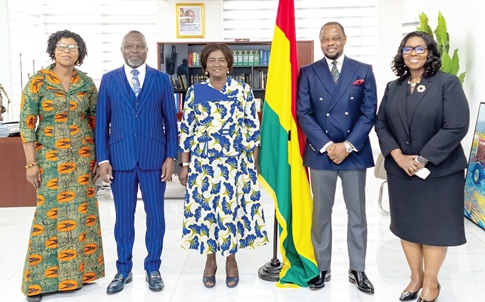
The Attorney-General and Minister of Justice has expressed worry about the rising cases of land compensation claims against the state, with some claimants demanding up to GH¢500 million per case.
Dr Dominic Akuritinga Ayine said preliminary assessments of the claims estimate liabilities running into billions of Ghana cedis.
Briefing the Vice-President, Professor Naana Jane Opoku-Agyemang, during a working visit to the ministry in Accra last Thursday, the Attorney-General said he had since directed the Solicitor-General to prepare a comprehensive brief for the President on the scale of the land compensation claims pending at the court.
He said the claimants had pulled up documents with which they argued that compensation had not been paid to them.
Dr Ayine cautioned that if care was not taken, the land compensation cases could pose a far more serious fiscal risk.
“The claimants frequently rely on archival documents to argue that compensation for lands acquired during the colonial era was never paid, and courts — sometimes up to the Supreme Court — have ruled in their favour,” the Attorney-General stated.
Visit
The Vice-President’s visit formed part of a broader engagement with key ministries to better understand their operational challenges and identify areas requiring government support.
She was accompanied by the Chief of Staff at the Vice-President’s Office, Alex Percival Segbefia, and other officials.
With the minister were the Deputy Minister of Justice and Attorney-General, Dr Justice Srem-Sai, as well as management, staff, and heads of agencies under the ministry.
No plea
Dr Ayine rejected claims that his office had entered into any plea or negotiations with individuals linked to the Operation Recover All Loot (ORAL) cases.
Addressing concerns raised in some media reports, he disclosed that 16 dockets related to the ORAL cases were currently under critical review in collaboration with investigative agencies.
“We have 16 dockets under review, and these will go through a process of critical scrutiny.
Where we identify loopholes in the investigations, we will ask the investigative authorities to provide additional evidence,” Dr Ayine said.
He stressed that none of the dockets submitted to his office had been compromised in any way.
Dr Ayine cited the ongoing National Service Secretariat prosecution as an example and assured Ghanaians that individuals found culpable would be held accountable under the law.
International arbitration
Dr Ayine said the government was currently facing 10 international arbitration cases, most of which were inherited upon assumption of office.
“One new arbitration was filed last year against the government of Ghana by a company known as Blue Gold,” he disclosed.
He stressed that although the events that triggered the case predated his tenure, his office was treating it with full responsibility.
“The state is our only client, and we must defend its interests as much as possible,” he said.
Criminal Proceeds Recovery Bill
The Attorney-General announced plans to introduce a Criminal Proceeds Recovery Bill, which would empower his office to confiscate assets linked to criminal activity.
Under current law, he explained, agencies such as the Economic and Organised Crime Office (EOCO) had seizure powers, but the Attorney-General, in spite of holding constitutional prosecutorial authority, did not.
The proposed legislation, he added, would allow both criminal confiscation and civil recovery of illicit assets, lowering the burden of proof and enabling the state to seize properties linked to crime under a lower standard of proof.
Dr Ayine cited South Africa’s model, where seized luxury assets are retained by the prosecuting authority.
Solution
The Vice-President urged the Ministry of Justice to propose innovative and sustainable approaches to land compensation, including alternative models that could reduce the financial strain on the state while remaining fair and just.
“We rely on you to advise us on what is workable, what is practical and what is enduring, so that we don’t leave legacies that trouble us in the future to avoid passing unresolved burdens on to future generations,” Prof. Opoku-Agyemang stressed.
“All of a sudden, we are remembering the colonial times.
Maybe these are things that have been in the pipeline for a long time, and people are finally frustrated, but we need to find solutions because the figures are mind-boggling,” she said.
Prof. Opoku-Agyemang commended the Office of the Attorney-General for its handling of international arbitration matters, adding that regardless of who initiated such disputes, the consequences ultimately fall on the state.
“It’s still about the country,” she said, adding that public officials must exercise greater caution in decision-making to avoid costly legal legacies that burden future administrations.
On issues of plea bargaining, she stressed the importance of continuous public education to prevent misinformation.
The Vice-President encouraged continuous learning from past cases, adding that while some served as warnings, others provided valuable lessons that could strengthen governance.
Prof. Opoku-Agyemang expressed concern about the strain on legal officers at the Attorney-General’s Office, describing the situation as unsustainable in spite of discussions around compensation.
She stressed the need for expanded training and recruitment rather than reliance on overworked staff.
