
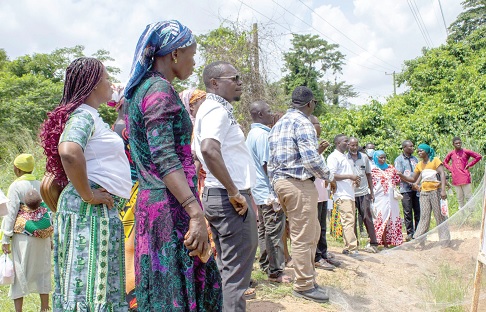
Scaling-up local rice production: Rice farmers, millers undergo training in good agronomic practices
One major challenge confronting the Ghanaian economy is the high importation of rice into the country.
Although rice is a common staple food on most Ghanaian tables, what is consumed locally in many homes is imported, a development that continues to have negative repercussions on local rice production.
Sadly, the nation produces only half of the rice it consumes annually, while the remaining is imported, costing about $500 million annually, with its attendant consequences on local rice production and the country’s economy as well.
Therefore, increasing local rice production through better seed selection and proper agronomic practices is essential towards reducing the costly dependence on foreign rice imported into the country.
KAFACI rice project
In a bid to shore up local rice production in Ghana, the Korea-Africa Food and Agriculture Cooperation Initiative (KAFACI), in partnership with the CSIR-Crops Research Institute, has rolled out the KAFACI rice project to develop rice varieties that meet the needs of consumers.
The Korea-Africa Food and Agriculture Cooperation Initiative (KAFACI) is a Korea-led partnership with 31 African countries run by Korea’s Rural Development Administration (RDA). It focuses on sharing Korean agricultural technology to boost food security in Africa.
Over the past decade, the project has helped the Crops Research Institute to release more than 10 rice varieties, which include both upland and lowland varieties and are also climate-smart as well.
One example of such climate-smart rice varieties supported by the KAFACI Rice project is CRI-Agyapa. This variety is a lowland rice variety that is early-maturing (105 to 115 days), making it unique, given the erratic nature of rainfall due to climate change.
Another key component of the project is the training of rice farmers, millers, aggregators and other key value-chain actors with the objective to build their capacity and to enable them to increase their yield.
Training
As a result, a day’s training on good agronomic practices in rice has been organised for selected stakeholders made up of rice farmers, millers and aggregators at CSIR-Crops Research Institute at Fumesua in the Ashanti Region.
They were taken through seed integrity and varietal selection, land preparation, water and soil fertility management, weed management in rice, post-harvest handling of rice and field visit (practical session).
Addressing the participants, the Principal Investigator, KAFACI Rice Project, Dr Kirpal Agyemang Ofosu, said the mandate of CSIR-CRI was to develop technologies which are always disseminated to farmers for application.
He acknowledged that CRI received support as part of the KAFACI rice project ostensibly to scale up technologies developed in relation to rice for onward translation to beneficiary farmers.
He noted that although the institution’s research yield for rice was around 8.5 tonnes per hectare, unfortunately, when the same seed gets to the farmer’s field, the figure drops to 3.5 tonnes per hectare.
He said, “obviously, this development raises concern about value for money because if a researcher releases a variety yielding so much but the farmer gets very little from the same variety, then there is a challenge”.
Gap
“This situation tells you that there is a gap, and it is our duty to close this gap by educating the farmers through the KAFACI rice project to help farmers to increase their yield to better their lives”, he said.
He mentioned that Ghana importing foreign rice annually, costing huge sums of money,\ was not the best, saying “we believe that such monies can be used to improve local production for the benefit of the nation”.
“I will encourage the government to help rice farmers with inputs to reduce production costs.
If production costs reduce, then market price will also reduce, making it easier for consumers to buy them,” he said.
Further, he urged the government to regulate the importation of foreign rice into the country while giving special attention to local production, saying “this will force consumers to patronise the ones produced locally”.
Scientific ways
The Director, CSIR-CRI, Professor Maxwell D. Asante, said the training was to introduce the participants to the scientific ways of cultivating rice to enable them to get high yield.
“We are introducing farmers to more climate-smart varieties of rice and more sustainable ways of growing it to enable them to make more profits, which will go a long way to improve their living conditions”.
He indicated that the introduction of new technology and continuous training were not enough to improve local rice production, saying, “the policy environment must be good so that farmers can get market for their product”.
Policy
He entreated the government to reintroduce the policy of quota system in relation to rice importation, stressing “if the numbers show that we can produce 60 per cent locally, then we can allow the remaining 40 per cent to be imported while ensuring that we reach 100 per cent local production”.
He said, “If we continue to have policy incoherence, it will not help, as farmers are ready and technology to scale-up is readily available.
We have everything to be self-sufficient in rice and achieve 100 per cent local production”.
Participants speak
A seed producer, Cosmos Kwesi Addae Djapong, underscored the relevance of the training as it was important for farmers to know the right varieties, how to plant them and harvest in order to get the right market.
A farmer, Lamisi Awupugi, said the training exposed her to new knowledge that would enhance her farming activity.
Writer’s email;
