
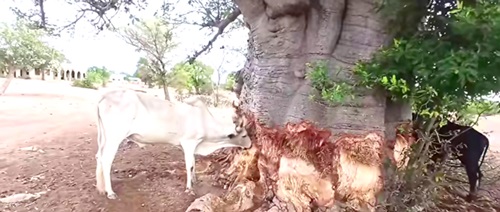
In most communities across the Upper East Region, the land has become bare, with vast stretches of grassland that once provided abundant pasture for livestock having disappeared, leaving cattle, goats and sheep struggling to find enough feed to survive.
The dwindling vegetation cover is increasingly becoming a source of concern for farmers and livestock rearers who depend largely on animal husbandry as a major source of livelihood.
What was once a seasonal challenge during a short period of the dry season has now evolved into a persistent crisis, affecting both livestock production and household incomes.
In many communities across districts such as Bolgatanga East, Bongo, Talensi, Bawku West and Nabdam, animals, particularly cattle, can be seen stripping the bark of baobab and moringa tree trunks and feeding on their leaves in a desperate attempt to survive.
While the trees are helping to sustain livestock through the harsh conditions, the excessive feeding is threatening their survival.
Farmers say many baobab trees have suffered extensive damage, with some gradually dying after repeated attacks by hungry animals.
This development is creating a double burden for these communities as their livestock are increasingly becoming weak and vulnerable to diseases due to inadequate nutrition, while the destruction of valuable tree species is reducing the region's environmental resilience and threatening these economic trees that many households depend on for food, medicine and income.
The unfolding crisis and its interconnectedness on livelihoods and ecosystem also reflects the growing impact of climate change on the Upper East Region, where erratic rainfall patterns, prolonged dry spells and rising temperatures have significantly reduced the availability of natural pasture.
The diverse impact
Farmers say the worsening feed shortage is causing animals to lose weight rapidly, making them vulnerable to diseases, reducing their market value and limiting their ability to be used for ploughing.
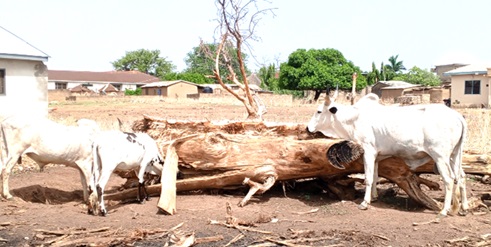
In some instances, the bulls have become too weak to help owners plough their lands for farming.
A livestock rearer at Zuarungu in the Bolgatanga East District, Simon Atanga, noted that "in the past, even during the dry season, our animals could find some grass to survive on; but the situation is different today.
The cattle are feeding on baobab bark and moringa leaves because there is virtually nothing left on the grazing fields. I have already lost two of my cattle this dry season."
Another livestock rearer from the Bongo District, Ayamga Akolgo, said the situation had become increasingly difficult, lamenting that he had lost five cattle this year, with two dying and three going missing.
"It is largely because of the lack of grass for them to feed on. This year in particular is unusual and, if you go around our baobab trees, you will realise how serious the situation is.
Most animals have resorted to feeding on them for survival," Mr Akolgo stated
Impact on farms
In many of these farming communities, bulls remain an important source of power for ploughing farmlands at the beginning of the cropping season. However, poor feeding conditions have left many animals too weak to perform that role.
A mixed farmer, Thomas Anaba, said inadequate feed had affected his farming operations, saying, "My bulls are too weak to plough.
Last season was manageable, but this season, they are too weak, and I will have to hire tractor services, which are not always reliable in this area."
Climate change
Over the years, the Upper East Region has recorded rising temperatures, delayed rainfall, prolonged dry spells and shorter rainy seasons.
These changes have reduced the growth of grasses and other natural forage crops that livestock depend on.
Experts and farmers attribute much of the problem to climate change and the increasingly unpredictable weather conditions being experienced across northern Ghana, coupled with human activities such as bush burning and illegal mining.
The Upper East Regional Director of Agriculture, Alhaji Zakaria Fuseini, linked the growing feed shortage to environmental degradation caused by illegal mining activities.
According to him, illegal mining operations are destroying fertile lands and vegetation that would otherwise support grazing and agricultural activities.
"Climate change has undoubtedly reduced the availability of pasture in the region, but what has contributed significantly to the problem are human activities.
Look at how lands are being degraded in the name of mining. Not only are animals starving, but these activities are also gradually affecting crop production," he stated.
The Nabdam District Commander of the Ghana National Fire Service, ADOI Awuni Akolgo, noted that another major contributing factor was the increasing occurrence of bushfires.
He explained that during every dry season, large expanses of vegetation are destroyed by fires, eliminating grasslands that could have served as fodder for livestock.
Proposed solutions
Agricultural experts and livestock farmers say there is an urgent need to address the worsening livestock feed crisis in the Upper East Region before the situation becomes irreversible.
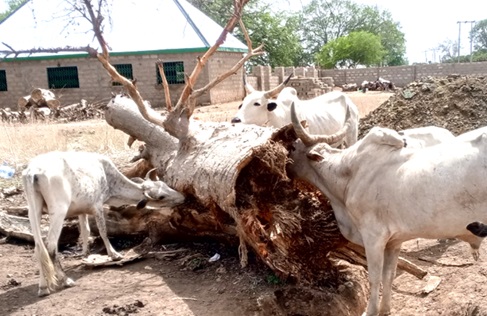
Cattle are starving without grasslands
Among the key proposals being advanced are the establishment of community fodder banks to store feed for use during the dry season rather than relying mainly on free grazing, as well as the enforcement of bylaws to restrict illegal mining activities and bush burning.
A livestock farmer from the Bawku West District, Charles Ayaaba, indicated that "at our level as livestock farmers, I think it is time for us to develop the habit of storing feed for animals for the dry season rather than sitting aloof and hoping for the best."
Beyond farmer-led solutions, key state institutions are also being called upon to take stronger action to protect the environment and restore grazing systems.
The Nabdam District Chief Executive (DCE), Francis Yenwona Tobig, said the Assembly was taking steps to strengthen environmental protection and promote sustainable land-use practices.
He said the Assembly was reviewing and finalising bylaws aimed at tightening environmental management, particularly in relation to bushfires, land degradation and tree protection.
"We are gradually being pushed to a point where everything becomes expensive because of our own activities. But the Assembly is committed to protecting our environment so that our young seedlings and tree species can survive," he said.
The Upper East Regional Director of Agriculture, Alhaji Zakaria Fuseini, also emphasised the importance of climate-smart agricultural practices as a long-term solution to the crisis.
He noted that improving pasture management, promoting drought-tolerant fodder crops and educating farmers on sustainable livestock rearing practices would help reduce pressure on natural vegetation.
