
Works and Housing Ministry deploying multiple strategies to reduce housing deficit
The Ministry for Works and Housing is pursuing multiple strategies to reduce the country’s 1.83 million housing deficit, including affordable housing.
The strategies include the redevelopment and completion of existing housing projects, leveraging public-private partnerships and relying on state-owned entities such as State Housing and TDC to deliver housing units.
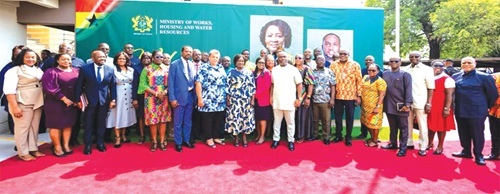
The Minister for Works and Housing, Kenneth Gilbert Adjei, was briefing the Vice-President, Professor Naana Jane Opoku-Agyemang, when she embarked on a working visit to the ministry as part of a tour of the ministries and agencies.
Visit
The Vice-President’s visit was part of a broader engagement with key ministries to understand their challenges and support their needs.
She had earlier visited the ministries of Education, Health, Gender, Children and Social Protection, Energy and Trade, among others.
Prof. Opoku-Agyemang was accompanied by the Chief of Staff in her office, Alex Percival Segbefia, along with other staff.
Projects
The Works and Housing Minister informed the Vice-President and her entourage that about 800 affordable housing units were being delivered progressively by TDC Ghana Limited, while arrangements were advanced to resume work on the stalled Saglemi Housing Project, with agreements currently undergoing final review at the Office of the Attorney-General.
Mr Adjei said SHC projects at Tema and Adenta, including the SHC Gardens, were also nearing completion.
In addition, he said, the National Home Ownership Fund had completed 129 housing units at Tema Community 22, and was awaiting inauguration, with another 50 units at Shai Hills, expected to be completed by the end of the second quarter of the year.
To deepen private sector participation, Mr Adjei announced the commencement of the Oxygen City project in Ho, spearheaded by TDC, with plans to replicate similar developments in Kumasi and other regions.
Redevelopment Projects
Addressing accommodation challenges faced by public servants, the Works and Housing Minister said the ministry was implementing a redevelopment programme, under which 195 housing units had been completed and allocated.
Mr Adjei said an additional 430 units were expected to be completed in the coming year to further ease accommodation pressures.
The Works and Housing Minister also briefed the Vice-President and her entourage on a number of sub-sectors, including improving the regulatory environment, coastal protection and drainage management system towards building a resilient and sustainable built environment, improving access to potable water across the country, and the National Rental Assistance Scheme, which had supported 4,732 people so far with GH¢71.7 million.
Mr Adjei, however, pointed out that the interventions in the sector were capital intensive and required adequate funding to sustain and scale up the programmes.
Communicate with citizens
The Vice-President urged the ministry to constantly and proactively communicate with citizens to better understand the government’s plans, future directions and the rationale behind difficult policy decisions and not only when disasters occurred.
She said even when citizens disagreed with government actions, engaging those whose lives were directly affected and helping them to understand the reasons behind such decisions could build trust and foster cooperation, describing communication as a critical but often overlooked aspect of governance, particularly during periods of crisis, and urged the ministry to intensify public education efforts to discourage construction in waterways and flood-prone areas.
On the issue of flooding, the Vice -President observed that the country experienced the same disasters year after year, followed by public outcry and temporary relief, only for the cycle to repeat itself.
“Sometimes you are not in a position to do the things that are popular, but you do the things that are necessary,” she said,
She added that while demolishing structures might be painful, the loss of lives to flooding was far more tragic.
Housing
Touching on housing, the Vice-President reflected on the ongoing debates around rent control and affordability.
She said the private sector played a significant role in housing delivery, and called for deeper conversations between institutions.
Prof. Opoku-Agyemang raised concerns about whether long-term housing investments, such as hostels, should attract the same loan conditions as short-term, high-turnover businesses, and suggested that financial policies should be aligned with development goals.
The Vice-President urged the leaders within the built environment to pay attention to people who permanently lived in underserved communities, stressing that they too deserved improved housing conditions.
“It cannot only be about us.
There are people who live there all the time.
What are we doing about their lives,” she asked.
On coastal management, Vice-President Opoku-Agyemang acknowledged the increasing threats facing coastal communities and urged that interventions should be designed with direct input from users, especially fisherfolk.
She warned that infrastructure development projects which ignored local realities could end up damaging boats or livelihoods, undermining the very purpose of the investment.
