
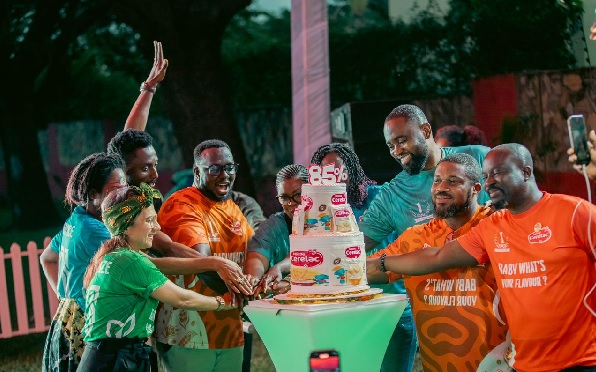
Nestlé Ghana celebrates Cerelac’s 85% market share, highlights local sourcing, economic impact
Nestlé Ghana has marked Cerelac’s commanding 85% market share, celebrating the brand's dominance in the baby cereal segment on Friday, September 26, in Accra.
The well-attended event brought together company staff to relive cherished childhood memories through a variety of nostalgic activities.
Highlights of the day included face painting, drawing sessions, nursery rhymes and recitals, dance competitions, relay walks, baby dressing contests, and foosball games.
Staff were grouped into four teams — Team Rice, Team Maize, Team Wheat, and Team Fruit — to compete in fun challenges such as rhyming, dancing, and word identification.
Adding to the excitement, popular Ghanaian music duo Dope Nation thrilled the crowd with energetic performances, prompting enthusiastic sing-alongs and dancing.
DJ Faculty of TV3 fame also entertained the audience with a lively set that kept spirits high throughout the event.
Cerelac's role
Speaking at the event, Corporate Communications Manager Mrs Deborah Kwablah emphasized Cerelac’s dual role in providing infant nutrition and supporting Ghana’s economy.
She said key raw materials like maize, rice, and wheat are sourced locally, with Nestlé investing directly in farmers through input support, agronomy training, and quality assurance to meet the brand’s high production standards.
She mentioned that the local sourcing strategy not only ensures product quality but also enhances farmer livelihoods and contributes to national development, reinforcing Cerelac’s position as both a market leader and a driver of economic growth.
"When you look around you see that we are wearing different colored T-shirts. We have the maize team, we have the wheat team and we have the rice team. What that is telling us is that these raw materials make Cerelac and we buy rice for Ghana for the production of Cerelac we buy maize from Ghana for the production of Cerelac and we buy wheat flour also when we can find it in the local market," she said.
"We do this very specifically as Nestle because we believe that if we contribute to the economic development of the country, if we contribute to what farmers are putting out there in the market we can contribute to their livelihood but more importantly contribute to the building of the nation," she added.
Product quality
Category Manager for Nutrition, Nestle Coastal Cluster, Kwabena Asiedu-Adarkwah emphasized the importance of maintaining product quality while driving growth through innovation to meet evolving consumer needs.
Despite holding an 85 per cent market share, he stressed that the goal is to continue leading by introducing relevant, nourishing, and consumer-focused products.
He highlighted the emotional connection Ghanaians have with Cerelac, describing it as more than a brand — it's part of cherished childhood memories and family traditions.
In response to economic challenges and reduced consumer spending, Asiedu-Adarkwah explained that the company is adapting by introducing smaller, affordable packaging and new product variants (like the Wheaten Meats), aimed at lower-income families.
This he said ensures continued access to nutritious food, helping retain customers within the category rather than losing them due to financial constraints.
Ultimately, he reinforced the brand’s commitment to innovation, inclusion, and sustaining its leadership in the Ghanaian market.
