

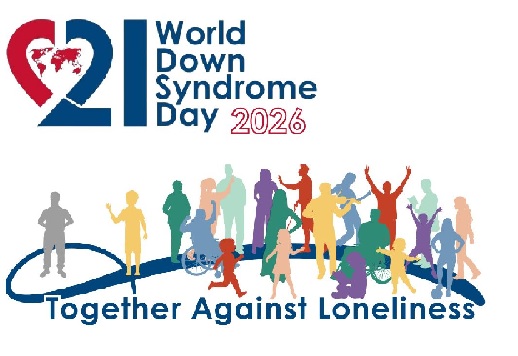
World Down Syndrome Day is here
Saturday, March 21, 2026, is the 21st anniversary of World Down Syndrome Day.
The selection of the third month of the year, March, and the 21st day speaks to the uniqueness of the underlying genetic anomaly of people with Down Syndrome who have three copies of the 21st chromosome.
The official theme for World Down Syndrome Day this year is “Together Against Loneliness which emphasises the importance of social connection, meaningful relationships, and community support for individuals with Down Syndrome and their families.
Recognising the increasing effects of loneliness on mental and physical health underpins the choice of the theme.
Down syndrome is a condition in which a child inherits extra genetic material from his/her parents.
This inheritance results in delays in the child's development, both intellectually and physically. The condition is named after a British doctor, Dr John Langdon Down, who first described it in 1887. Its frequency of occurrence is estimated to be one in every 800 babies.
The reason why Down Syndrome occurs is not exactly known, but it results from an error in the way the chromosomes, which are vehicles of inheritance called chromosomes, arrange themselves. Although any woman can give birth to a child with Down syndrome, women aged 35 years and above have a significantly increased risk of having a child with the condition.
Normally, at the time of conception, a baby inherits genetic information from both parents. These genetic materials are 46 in number: twenty-three (23) from the mother and 23 from the father.
In most cases of Down Syndrome, a child gets an extra copy of the genetic material- either in whole or in part - located on number 21 of the genetic material or chromosome 21, making a total of 47 instead of 46 chromosomes.
It is this extra genetic material that causes the physical features and developmental effects seen in children with Down syndrome.
By the time a female child is born, the eggs in her ovary are in a certain stage of cell division where the genetic materials are in a mesh-like network, making direct contact with each other.
They continue to remain in contact with each other as the child grows, all the way to ovulation, where that egg quickly divides to form a mature egg and another immature one called a polar body.
Because these genetic materials have been in contact with each other for so long, they form strong bonds with each other, such that separating them becomes difficult as the cell divides.
The more advanced in years the woman is during ovulation, the longer the contact period for the genetic material and the more difficult it becomes to separate them. Thus, extra copy of the chromosome is pulled by the other.
This process is called non-disjunction and is mostly seen in women older than 35 years of age with children with Down Syndrome.
With non-disjunction, a sperm or egg cell is produced with an extra copy of chromosome 21, making that sperm or egg have 24 chromosomes instead of 23.
When combined with a normal egg or sperm from the other parent, the embryo gets 47 chromosomes, with three copies of chromosome 21. In this type, all the cells in the body have an extra copy of chromosome 21.
Sometimes, some of the cells in the body have normal 23 copies of chromosomes, and other cells have extra copies of 21; this is called Mosaicism and they exhibit milder features of the condition.
Another way of getting extra genetic material on chromosome 21 is a form called translocation.
In this case, the long arm of chromosome 21 becomes attached to another chromosome, often chromosome 14. Thus, extra genetic material on chromosome 21 is inherited. Down syndrome arising from a translocation is often referred to as familial Down syndrome.
It does not show the maternal age effect and can be seen in younger mothers, and the extra genetic material is just as likely to have come from fathers as mothers.
Rarely, a region on chromosome 21 will undergo a duplication event leading to extra copies of some, but not all, of the genes on chromosome 21.
If the duplicated region has genes that are responsible for Down Syndrome's physical and mental characteristics, the resultant babies or individuals will show those characteristics.
The physical features and medical problems associated with Down Syndrome can vary widely among individuals. Some people with the condition can lead a normal life, while others need a lot of medical attention and support.
Common physical features include a flat facial profile, an upward slant to the eyes, a widened space between the eyes, small and low-set ears and a protruding tongue.
Other features are short stubby fingers, a single crease in the palms and a wide gap between the first and second toes.
At birth, children with Down syndrome are usually of average size, but they tend to grow at a slower rate and remain smaller than their peers. For infants, low muscle tone may contribute to sucking and feeding problems as well as their floppy appearance.
They also have constipation and other digestive issues. Toddlers and older children may have delays in speech and self-care skills like feeding, dressing, and toilet-training. One of the constant features of Down Syndrome is delayed development.
Down Syndrome affects the person’s ability to learn in different ways, but most have mild to moderate intellectual impairment. However, children with the condition can and do learn and are capable of developing skills throughout their lives.
They simply reach their goals at a different pace, which is why it is important to avoid comparing a child with Down Syndrome to another sibling or even other children with the condition, because they always have intellectual disabilities, though to varying degrees.
The writer is a member of the Paediatric Society of Ghana and the Director of Medical Affairs, Korle Bu Teaching Hospital.
