
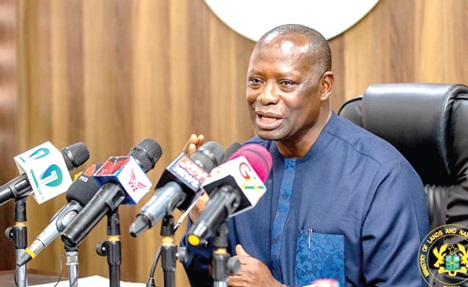
New mineral royalties regime in the offing
The government is working on a new instrument to guide royalty payments across the country's mining sector.
The new regime adopts the sliding scale royalty regime, a tax system where the royalty rate varies based on a project's financial or production metrics, such as the commodity price or output level.
The new dawn is a departure from the current static royalty regime and provides a more responsive mechanism for the country to get the right royalties.
The Minister of Lands and Natural Resources, Emmanuel Armah-Kofi Buah, who made this known yesterday, said the instrument had already been developed in collaboration with the Attorney-General and Minister of Justice, and would be laid in Parliament upon Cabinet approval.
“This structure is designed to safeguard investments while maintaining a competitive based royalty during periods of low prices,” he said.
Mr Buah stressed that the new royalty regime being explored was a comprehensive approach and would not be limited to lithium, but also for gold, diamond and other minerals.
Context
After six years of exploratory activities, the government granted the first-ever mining lease for lithium to Barari DV Ghana Ltd, a subsidiary of Australia-based Atlantic Lithium on October 19, 2023.
The $250-million project, located at Ewoyaa in the Mfantseman Municipality in the Central Region, was expected to commence production by 2025.
It is a 15-year lease agreement over an area of approximately 42.63 square kilometres.
Per the mining lease which was in line with the country’s Green Minerals Policy, there was an increase in royalties rate from the standard five per cent to 10 per cent.
However, following the delays in parliamentary ratification of the lithium agreement and the downturn in lithium prices across the world, the lease owners are currently negotiating with the government for a reduction in the royalty rate.
Touching on the status of the lithium project, Mr Buah said the focus of the government now was to get the new royalties instrument approved by Parliament to ensure a win-win situation for the state and the company.
He indicated that parliamentary ratification of the lithium deal was presently on hold pending the commencement of the new royalty regime.
The minister said the recent downturn in lithium prices had put many lithium projects around the world on hold, and the Ewoyaa project was not an isolated issue.
Mr Buah described the new royalty regime as an excellent opportunity to review the entire royalty regime.
“We know that jobs will be lost, the economy will be affected and we are aware of that. The new market rates call for a revision of the fiscal terms to protect the national interest,” he said.
Stakeholder interest
Mr Buah said the government was aware that the stakes were high in the Ewoyaa lithium project, the reason why steps were being taken to do what was prudent and in the national interest.
He said the Central Regional House of Chiefs had engaged the government, and a strong case on why the project could not stall and why it was critical to the region and the country.
