
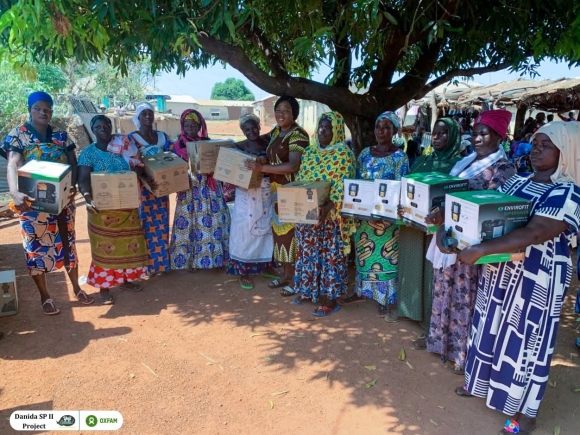
Promoting clean energy: YEFL Ghana distributes cookstoves to women in North East, Savannah Regions
Northern Ghana continues to experience rapid warming, erratic rainfall patterns and prolonged dry spells that threaten livelihoods, agriculture and local ecosystems.
In communities such as Wulugu in the North East Region and Buipe in the Savannah Region, households rely heavily on firewood and charcoal for cooking. However, these fuels are becoming increasingly scarce, forcing women to walk long distances to collect wood while contributing to deforestation and environmental degradation.
According to the United Nations Development Programme (UNDP), the Northern Savannah Zone, which spans roughly 9.7 million hectares, lost more than 77 per cent of its woodland cover between 2001 and 2015, largely due to fuelwood harvesting and charcoal production.
In response, Youth Empowerment for Life (YEFL) Ghana, with support from Oxfam under the DANIDA Strategic Partnership II Programme, has rolled out a climate-resilient, gender-focused intervention aimed at reducing reliance on biomass, promoting cleaner energy and improving household wellbeing.
As part of the initiative, 200 energy-efficient cookstoves have been distributed to women in Wulugu and Buipe to reduce the use of fuelwood and charcoal. The items include 50 firewood-efficient models and 150 charcoal-efficient stoves, designed to cut charcoal consumption by up to 80 per cent. The project has also trained 40 young people, including 20 Fulbe youth, as Youth Environmental Brigades to champion climate awareness, lead regreening activities and promote peaceful agro-pastoral coexistence in the face of climate stress.
Climate resilience
Presenting the items to beneficiaries at separate ceremonies, DANIDA SP II Project Lead at YEFL Ghana, Emmanuel Ndukwe, said the intervention was aimed at promoting climate-resilient and gender-sensitive solutions in the beneficiary areas. He said empowering women with cleaner alternatives and equipping young people to lead environmental action would significantly reduce deforestation and strengthen community resilience.
He added that the initiative complements ongoing advocacy for reduced LPG prices and the expansion of LPG distribution points in rural communities to improve access to modern cooking energy.
“These energy-efficient cookstoves reduce fuelwood use by nearly 80 per cent and cut harmful emissions that mainly affect women. This is a meaningful step towards safeguarding forest resources while improving health and household savings,” Mr Ndukwe said.
YEFL Ghana is ensuring the sustainability of the project by training the Youth Environmental Brigades to lead climate awareness campaigns, support regreening efforts and promote peaceful coexistence in areas where climate change often intensifies resource-based conflicts. The organisation believes that empowering women with cleaner alternatives and preparing young people to take charge of environmental action are crucial to reducing deforestation and building resilient communities.
Gratitude
Some beneficiaries who spoke to the GraphicOnline expressed appreciation for the gesture, noting that the cookstoves would reduce the health hazards associated with traditional fuelwood use while protecting the environment.
A beneficiary, Amina Mohammed, said, “This stove uses very little charcoal. Before, I used to buy charcoal almost every week, but now I save money and cook faster. The smoke is minimal.”
Another beneficiary, Salamatu Salifu, said the use of the stoves would help preserve the environment, particularly shea trees, which were often cut down for fuelwood.
